

Urgent Care CPT Codes: Coding Guide, E/M and POS 20
Urgent care CPT codes explained: POS 20, office E/M 99202-99215, S9083 and S9088, modifier 25, QW labs, and Florida workers comp.
Quick Summary: Urgent Care CPT Codes and POS 20
Most urgent care visits are billed with an office or outpatient E/M code from 99202 to 99215 and place of service 20. Procedures, injections, imaging and point-of-care tests are added as separate lines, and modifier 25 goes on the E/M only when it is truly separate from the procedure.
- POS 20 is the place of service code for an urgent care facility.
- Visit level comes from medical decision making or total time, using 99202 to 99205 (new) and 99212 to 99215 (established).
- S9083 and S9088 are HCPCS codes that depend on the payer contract, and Medicare does not pay S codes.
- Modifier 25, the QW modifier and the Florida workers comp rules cause many urgent care denials.
Urgent Care Coding Explained
Urgent care CPT codes are the office and outpatient E/M codes, 99202 to 99205 for new patients and 99212 to 99215 for established patients, reported with place of service (POS) 20. The level you pick comes from medical decision making (MDM) or total time on the date of the visit. Anything else done at the visit, such as a laceration repair, an injection, a nebulizer treatment, a splint or an X-ray, is reported on its own line. This guide covers each of those pieces, the modifiers that connect them, and the denials that follow when they are wrong.
Medsure RCS codes and bills urgent care claims for Florida practices, and this page reflects the checks those claims go through before they are sent. It sits under our urgent care billing hub. The global fee codes get their own page, HCPCS S9083. For the level-selection rules behind the visit codes, see E/M coding. Orlando centers can also work with our urgent care medical billing in Orlando team, and every rejected claim goes through our denial management process. Patients sent on to the emergency department are leveled under different rules, covered in ED E/M level coding.
What Does POS 20 Mean for Urgent Care
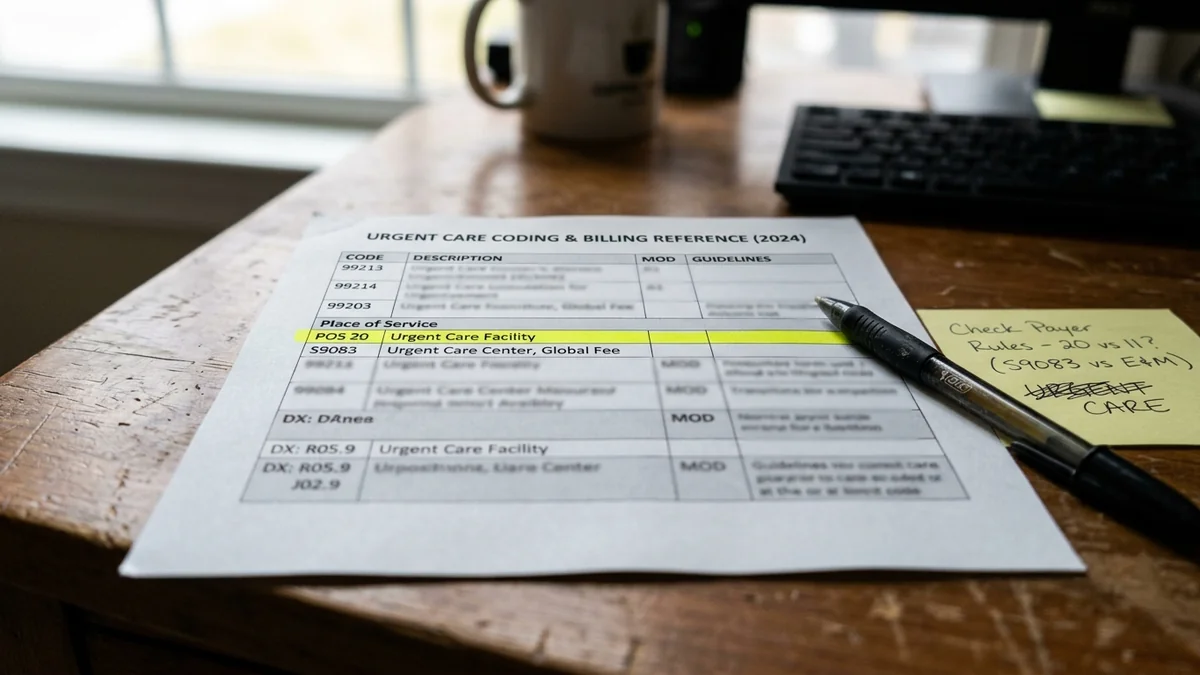
CMS defines POS 20 as an urgent care facility: a location separate from a hospital emergency room, an office or a clinic, set up to diagnose and treat illness or injury for unscheduled, ambulatory patients who need immediate attention. POS 11 is the office code, and POS 23 is the hospital emergency room. The code you put on the claim tells the payer which rules and rates to apply, so a center that bills POS 11 by habit can be paid differently from one that bills POS 20, and some payers deny claims where the place of service does not match the contract. POS also decides which E/M family is allowed. The Medicare Claims Processing Manual says emergency department visit codes 99281 to 99285 are for patients seen in an emergency department, which it defines as an organized hospital-based facility for unscheduled or episodic services. They are not for an office or any other site of service. An urgent care center is not a hospital emergency department, so its visits use the office and outpatient codes, not ED codes, even when the patient arrives with an emergency-type complaint.
Urgent Care E/M Coding
How is Urgent Care E/M coding done?
- Since 2021, CPT lets you choose the office visit level by MDM or by total practitioner time on the date of the encounter. History and exam no longer set the level, and code 99201 was deleted. Time thresholds are minimums that must be met or exceeded.
- 99202: new patient, straightforward MDM, or at least 15 minutes total time.
- 99203: new patient, low MDM, or at least 30 minutes.
- 99204: new patient, moderate MDM, or at least 45 minutes.
- 99205: new patient, high MDM, or at least 60 minutes.
- 99211: established patient visit that may not need a physician or other qualified professional. It is not leveled by MDM or time.
- 99212: established patient, straightforward MDM, or at least 10 minutes.
- 99213: established patient, low MDM, or at least 20 minutes.
- 99214: established patient, moderate MDM, or at least 30 minutes.
- 99215: established patient, high MDM, or at least 40 minutes.
- Prolonged time: the CPT add-on 99417 is reported from 75 minutes. Medicare instead uses HCPCS G2212 with 99205 or 99215. In the CMS E/M guide, 99215 plus one unit of G2212 needs 69 to 83 minutes total.
When Do S9083 and S9088 Apply
S9083 is a HCPCS Level II code whose descriptor is a global fee for urgent care centers: one flat payment for the visit. S9088 is described as services provided in an urgent care center and is listed in addition to the code for the service. S codes are temporary national codes that private insurers use for needs that have no permanent national code. CMS says they are not payable by Medicare, so Medicare urgent care visits are billed with the itemized E/M and procedure codes above. Whether either code is accepted is a contract question. As one published example, an Ambetter of North Carolina provider notice effective August 1, 2026 says both codes are reimbursable only with POS 20, and that S9088 may be billed only alongside an E/M or procedure code for in-person care. That notice is one plan's rule, not a national one. Read each payer's contract and fee schedule before choosing global or itemized billing, and see our page on HCPCS S9083 for the trade-offs.
Urgent Care Procedure and Test Coding
How is Urgent Care Procedure and Test coding done?
- Laceration repair: 12001 to 12007 are simple repairs, 12031 to 12057 are intermediate (layered) repairs split by body area, and 13100 to 13160 are complex repairs. Pick the level from how the wound was closed, then the body site, then the total length in centimeters.
- Multiple wounds: code repairs in different anatomical groups on separate lines and list the more complex repair first.
- Injections: 96372 is a therapeutic, prophylactic or diagnostic injection given under the skin or into muscle. The drug itself is reported separately with its HCPCS J code.
- Nebulizer treatment: 94640 reports an inhalation breathing treatment. Some payers want modifier 25 on the E/M when both are billed.
- Splints and strapping: the 29xxx range covers casting, splinting and strapping by body area. For example, 29125 is a short arm splint. Splint supplies are reported with HCPCS Q codes.
- X-rays: imaging has a technical component (modifier TC) and a professional component (modifier 26). A practice that performs both components bills the code with no modifier. If a radiologist reads the film, the center bills the technical component only.
- Point-of-care labs: report the CPT code for the test. For Medicare, add the QW modifier so the test is recognized as CLIA waived.
Using Modifier 25 Correctly
How do I use Modifier 25 correctly?
Modifier 25 tells the payer that an E/M was significant and separately identifiable from a procedure done the same day. CMS's NCCI policy manual explains the rule. Minor procedures, with 0 or 10 day global periods, include the decision to perform the procedure, so that work cannot be billed as an E/M. Modifier 25 may be added to an E/M reported with a minor procedure only when the E/M goes beyond the usual pre-procedure, intra-procedure and post-procedure work. Being a new patient is not enough on its own. The manual's own example is a head injury where the provider sutures a laceration. Confirming allergies and consent is not a separate E/M, but a medically necessary full neurological exam may be. Document the separate problem and the separate work in the note. Our modifier 25 page covers this in more depth. One Medicare detail to watch: HCPCS G2211 is generally not paid when its base E/M code carries modifier 25, with exceptions for the annual wellness visit, vaccine administration and Part B preventive services.
How Are After-Hours Codes Paid
- 99050: reported with the E/M when a service is provided in the office outside regularly scheduled hours or on a day the office is normally closed.
- 99051: reported with the E/M when the service falls in regularly scheduled evening, weekend or holiday hours that the practice posts.
- 99053: reported with the E/M for services between 10 p.m. and 8 a.m. at a 24-hour facility such as an urgent care center (POS 20), where the place of service decides whether it applies.
- Posted hours decide between 99050 and 99051, so keep hours on the website, signage and payer records.
- Medicare and payers that follow its rules do not pay extra for after-hours services. Some private payers may, so negotiate these codes into the contract.
Florida Workers Comp Billing
How does Florida Workers Comp billing work?
Many urgent care centers in Florida treat work injuries, and these claims are not billed like group health claims. The Florida Division of Workers' Compensation publishes a Health Care Provider Reimbursement Manual (the 2024 edition took effect January 1, 2025) and a separate Health Care Provider Fee Schedule, with the 2025 fee schedule effective January 1, 2026. The treating provider also files form DFS-F5-DWC-25, which requests authorization for a treatment plan, reports medical status and documents maximum medical improvement. The Division's Medical Services FAQ notes that a carrier may deny reimbursement when the DWC-25 is not submitted as required. Before billing, confirm the carrier, the claim number, the authorization status and the current manual edition. Our Medicare billing and Florida Medicaid billing pages cover the government payers separately.
Common Urgent Care Denials
What are the most common Urgent Care denials?
- Wrong place of service: a claim with POS 11 when the contract expects POS 20, or the reverse, can be denied or paid at a different rate.
- S9088 billed alone: payers that accept it require an E/M or procedure code on the same claim.
- Missing modifier 25: the E/M is bundled into the procedure and denied or reduced.
- Unsupported modifier 25: the note shows only the usual pre-procedure work, so the E/M is recouped on audit.
- Missing QW: a waived lab test is denied because the claim does not show it as CLIA waived.
- ED code on an urgent care claim: emergency department codes 99281 to 99285 are for patients seen in an emergency department.
- Level not supported: the visit is coded 99214 or 99215 but the note supports less MDM or time.
- Workers comp claim sent to group health, or filed without a DWC-25: the carrier denies for wrong payer or missing documentation.
More Urgent Care Billing Services Guides
Related Services
Urgent Care Billing Services
Learn MoreHCPCS S9083: Global Fee for Urgent Care Centers
Learn MoreEvaluation and Management (E/M) Coding
Learn MoreModifier 25: Significant Separately Identifiable E/M Service
Learn MoreMedicare Billing Services
Learn MoreDenial Management Services in Florida
Learn MoreUrgent Care Coding, Frequently Asked Questions
POS 20. CMS defines it as an urgent care facility that is separate from a hospital emergency room, an office or a clinic and treats unscheduled walk-in patients with illness or injury. Use POS 11 for an office and POS 23 for a hospital emergency room.
Most urgent care visits use office or outpatient E/M codes: 99202 to 99205 for new patients and 99212 to 99215 for established patients. The level comes from medical decision making or total time on the date of the visit.
No. The Medicare Claims Processing Manual says emergency department codes are for patients seen in an emergency department, which it describes as an organized hospital-based facility. An urgent care center uses the office and outpatient codes.
No. CMS describes S codes as codes used by private insurers and states they are not payable by Medicare. Some commercial plans accept them under their contracts, so check each payer.
Add modifier 25 to the E/M when the provider did a significant, separately identifiable evaluation beyond the usual work of a minor procedure done the same day, such as a stitched laceration. The note must show that separate work. The decision to do the procedure is not billed as an E/M.
For Medicare, yes. CMS requires the QW modifier on HCPCS codes for CLIA waived tests so they are recognized as waived. Check each commercial payer's policy for its own rule.
The Florida Division of Workers' Compensation publishes a Health Care Provider Reimbursement Manual and a separate Health Care Provider Fee Schedule, which apply to work injury claims. Check the Division's site for the edition in effect on the date of service.
Ask About Urgent Care Coding
Ready to Improve Your Urgent Care Coding?
Talk to a Medsure RCS specialist. No commitment, no pressure, just answers.
Sign up for our newsletter to receive updates, industry news, and articles about medical billing and revenue cycle management.