
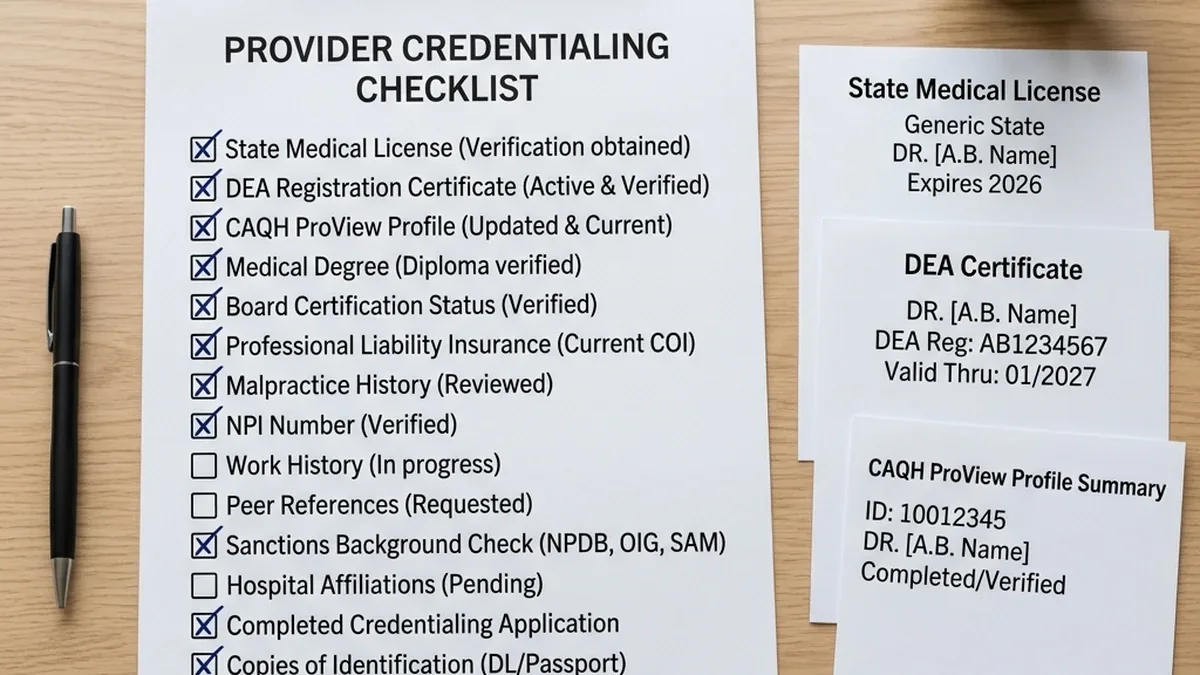
Provider credentialing is the process by which a healthcare provider is verified, approved, and enrolled with payers to deliver covered services to their insured patients. Without credentialing, claims submitted under the provider NPI will be denied as provider not enrolled. The credentialing process is lengthy by design: payers verify education, licensure, malpractice history, DEA registration, board certifications, and work history before approving enrollment.
Credentialing timelines are one of the most consistent sources of revenue disruption for new providers. Understanding the process, the timeline, and where delays typically occur helps practices plan accurately and avoid billing gaps. Our credentialing and enrollment services manage the complete workflow for Florida providers.
Step-by-Step Credentialing Process
- Step 1, CAQH ProView setup: Most commercial payers and many government payers require providers to complete and maintain a CAQH ProView profile. This centralizes provider information that payers pull during the credentialing review.
- Step 2, Payer application submission: Each payer requires its own enrollment application in addition to CAQH data. Applications include payer-specific contracts, W-9, and provider-specific attestations.
- Step 3, Primary source verification: The payer verifies education, training, licensure, board certification, and malpractice history directly with the issuing organizations. This takes the majority of the credentialing timeline.
- Step 4, Credentialing committee review: Larger payers and hospital medical staffs route applications through a credentialing committee that meets on a defined schedule.
- Step 5, Contract execution: Once approved, the provider receives a participation agreement to sign. The effective participation date begins on or after the contract execution date.
- Step 6, System loading: The payer loads the provider into its claims system. Claims cannot be processed until this step is complete. Our credentialing enrollment team follows up on this final step to prevent payment delays.
Typical Credentialing Timelines by Payer Type
Medicare credentialing through PECOS (Provider Enrollment, Chain, and Ownership System) typically takes 60 to 90 days. Florida Medicaid enrollment through AHCA/FMMIS takes 30 to 90 days, managed through our Medicaid credentialing services. Commercial payers vary most widely: some approve in 45 days; others, particularly Blue Cross Blue Shield plans, may take 90 to 120 days or longer.
Most Common Credentialing Delays
- Incomplete or inconsistent application information, a full CAQH ProView profile prevents most of these.
- CAQH profile not attested or updated within the required window, causing payer pulls to fail.
- Missing malpractice coverage documentation or gaps in work history that require explanation.
- Licensure or DEA certificate expired or with disciplinary history that requires additional review.
- Missed credentialing committee meeting dates due to late application submission.
- Failure to follow up on application status after submission.
Key Takeaways
- Medicare credentialing via PECOS and Medicaid enrollment through AHCA typically take 60 to 90 days.
- A complete and attested CAQH ProView profile is required before most payer applications can be processed.
- Claims submitted before the effective credentialing date will be denied even if the provider is otherwise qualified.
- The credentialing timeline should be planned before the provider start date.
- Regular follow-up with payers after application submission prevents avoidable delays.
Frequently Asked Questions
Can a provider bill during the credentialing period?
For Medicare, provisional billing or retrospective billing may be available under specific circumstances. Most commercial payers do not allow retrospective billing. Our credentialing services advise on provisional billing options during the enrollment period.
What is re-credentialing?
Re-credentialing is the periodic re-verification of a provider credentials by a payer, typically every two to three years. CAQH ProView re-attestation (required quarterly) keeps most information current for re-credentialing. Failure to complete re-credentialing results in termination from the payer network.
Does a group practice credential providers individually or as a group?
Both. The group practice entity is enrolled as the billing NPI, and each individual provider is credentialed separately as the rendering NPI. Our provider credentialing services manage both the group entity enrollment and each individual provider credentialing simultaneously.