

OA-23 Denial Code: Prior Payer Payment Adjustment
OA-23 indicates payment was adjusted due to a prior payer's payment. Learn how to apply OA-23 adjustments when processing secondary insurance claims.
What OA-23 Means and How to Resolve It
The impact of prior payer(s) adjudication including payments and/or adjustments.
- Ensure primary EOB is included when billing secondary payers.
- Use COB crossover billing where available to reduce manual routing errors.
Source: X12.org Official CARC Registry
OA-23 in Detail
What does OA-23 cover in detail?
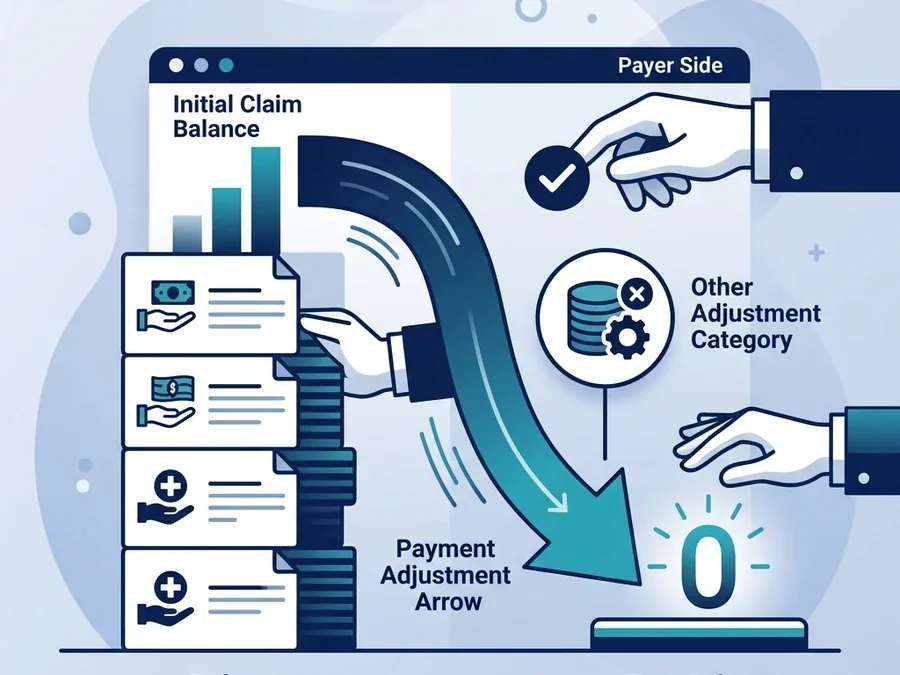
OA-23 indicates a coordination of benefits adjustment, the amount reduced because another payer has primary responsibility for this claim.
The OA-23 balance is posted as a COB adjustment in your payment posting workflow after the secondary carrier adjudicates. See the full denial codes reference for related CARC codes.
How to Handle OA-23 Denials
How to Handle OA-23 Denials?
Identify the Root Cause
Review the claim submission to find the specific reason. Check the modifier-procedure combination and payer-specific coding requirements.
Gather Documentation
Collect the clinical documentation, EOB, and any payer communication needed to support a corrected claim or appeal.
Correct and Resubmit
Make the appropriate corrections: update codes, modifiers, or attach documentation, then resubmit within the payer's timely filing window.
Track and Prevent
Log this denial type in your denial tracking system and implement a front-end check to prevent the same issue on future claims.
Appealing a OA-23 Denial
How do I appeal a OA-23 Denial?
Corrected Claim or Appeal
These are different routes and choosing wrong costs time. If the denial was caused by something fixable on your side, a wrong modifier, a missing authorization number, or a transposed code, submit a corrected claim. It is faster and does not consume an appeal level. File a formal appeal when the original claim was correct and you believe the payer applied its policy incorrectly.
What to Submit
Include the remittance advice showing the denial, the claim as originally submitted, the clinical documentation that supports medical necessity, and a short cover letter that cites the payer's own coverage policy. Take the filing deadline from the remittance advice or determination letter for that specific claim rather than a general rule, since it differs by payer and by appeal level.
Medicare Appeal Levels
Original Medicare fee-for-service appeals move through five levels, and each one must be exhausted before the next:
- 1Redetermination by the Medicare Administrative Contractor (MAC)
- 2Reconsideration by a Qualified Independent Contractor (QIC)
- 3Decision by the Office of Medicare Hearings and Appeals (OMHA)
- 4Review by the Medicare Appeals Council
- 5Judicial review in federal district court
Source: CMS, Medicare Fee-for-Service Appeals
OA-23, PR-23, PI-23: Why the Group Code Matters
The number 23 always carries the same reason for the adjustment. The two-letter group code in front of it decides who is left owing the balance, which is why the same denial reason can arrive as OA-23 on one remittance and PR-23 on another.
Contractual Obligation. The provider absorbs the amount under the payer contract and cannot bill the patient for it.
Patient Responsibility. The balance moves to the patient and may be billed, subject to the payer agreement.
Payer Initiated Reduction. The payer reduced payment on its own initiative, not under a contractual term.
Other Adjustment. Used when neither contractual obligation nor patient responsibility applies.
Group code definitions follow the X12 claim adjustment structure.
OA-23 Adjustment Reference
| Field | Details |
|---|---|
| CARC Code | OA-23 |
| Code Group | Other Adjustment (OA) |
| Official Description | The impact of prior payer(s) adjudication including payments and/or adjustments. |
| What It Means | This code is used by a secondary or tertiary payer to indicate that the adjustment amount reflects what the prior payer(s) already paid or adjusted. It is not a denial requiring action. |
| Billing Action | Apply the OA-23 adjustment as a secondary payer adjustment in your payment posting system. The remaining balance after primary and secondary adjudication is the patient responsibility. |
| Prevention | Ensure primary EOB is included when billing secondary payers. Use COB crossover billing where available to reduce manual routing errors. |
Source: X12.org Official CARC Registry
Related Billing Resources
OA-23, Frequently Asked Questions
The impact of prior payer(s) adjudication including payments and/or adjustments.
This code is used by a secondary or tertiary payer to indicate that the adjustment amount reflects what the prior payer(s) already paid or adjusted. It is not a denial requiring action.
Apply the OA-23 adjustment as a secondary payer adjustment in your payment posting system. The remaining balance after primary and secondary adjudication is the patient responsibility.
Ensure primary EOB is included when billing secondary payers. Use COB crossover billing where available to reduce manual routing errors.
Having Trouble With This Code?
Our billing specialists can help you resolve denials, improve coding accuracy, and reduce claim rejections.
Sign up for our newsletter to receive updates, industry news, and articles about medical billing and revenue cycle management.