

Evaluation and Management (E/M) Coding
E/M coding aligned with current AMA and CMS guidelines. Correct level selection that reduces audit risk and protects physician revenue.
How E/M Levels Are Selected
Evaluation and management levels are selected on medical decision making or total time, depending on the setting and the code family. Documentation has to support the level chosen, because downcoding on review and undercoding by habit both cost the practice revenue.
- Levels selected on documented decision making or total time
- Documentation reviewed against the level actually billed
- Undercoding identified alongside overcoding risk
- Setting-specific rules applied rather than one universal standard
Evaluation and Management Coding Explained
Evaluation and management (E/M) coding covers the office visits, hospital visits, consultations, and other patient encounters that make up the majority of physician billing. E/M codes (CPT 99202-99499) are among the most audited codes in medical billing because they represent significant Medicare spending and because selection errors are common in both directions, with both under-coding and over-coding creating financial and compliance consequences. The OIG consistently includes E/M coding in its annual Work Plan focus areas.
Medsure RCS applies E/M codes using the current AMA CPT guidelines, which shifted from history and physical examination-based level selection to medical decision making (MDM) or time-based selection effective January 2021 for office visits and 2023 for hospital visits. Accurate E/M coding under these guidelines requires clinical understanding of MDM complexity and familiarity with current AMA CPT definitions. E/M level patterns are reviewed as part of our medical coding audit program. E/M codes are a subset of CPT coding and drive the majority of revenue in physician billing services and across specialty medical billing practices. The two codes this matters most for are 99213 and 99214.
How It Works: Step by Step
Documentation Review for MDM or Time
We review the clinical note to assess whether the level is supported by MDM complexity or total physician time, per current AMA guidelines.
MDM Component Analysis
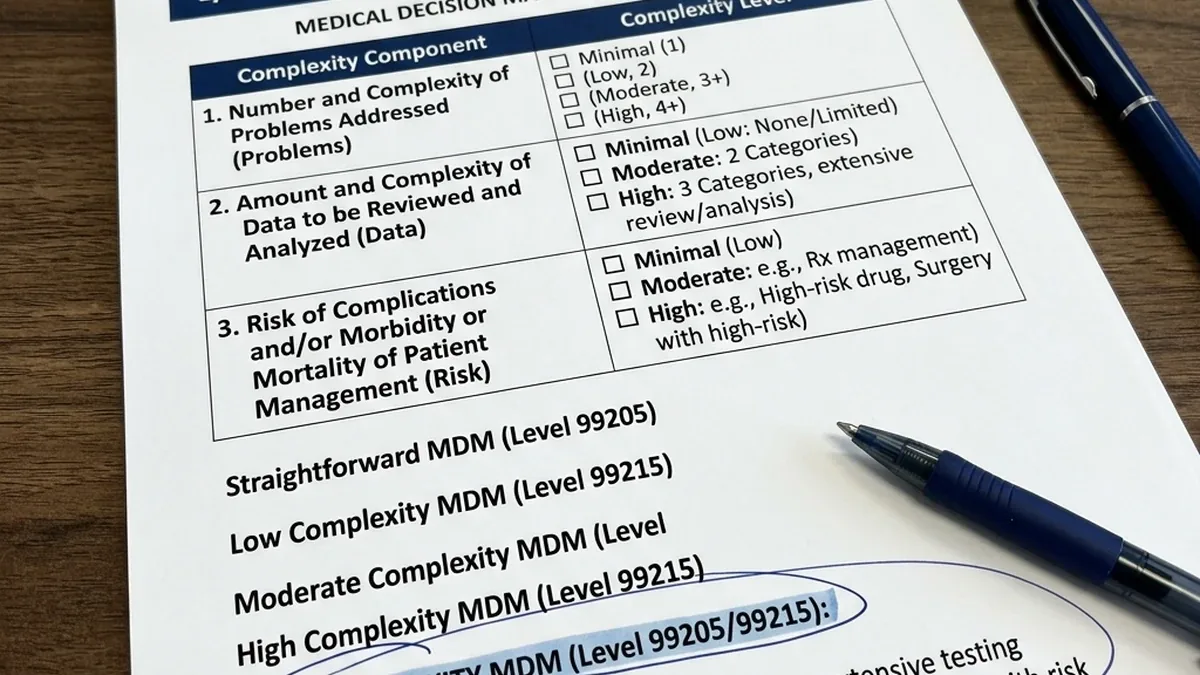
For MDM-based coding, we assess the three MDM components: number and complexity of problems, amount of data reviewed, and risk of complications or treatment decisions.
E/M Level Assignment
The appropriate E/M code level is assigned based on the higher of the MDM table result or documented total time, with the determination documented.
Audit Flag Review
Assigned levels are reviewed for statistical outliers by provider and specialty to identify patterns that warrant documentation coaching or internal audit.
The Impact of Accurate Coding
E/M coding applies the most current AMA E/M documentation guidelines, not pre-2021 legacy methods.
MDM-based level selection with documentation references is more defensible in payer and OIG audits.
Practices that shift from legacy history/exam-based coding often recover significant revenue through accurate MDM-based level assignment.
We apply both MDM and time-based methods and select the level supported by the documentation.
Common Mistakes in Evaluation and Management Coding
Still Using the Pre-2021 History and Physical Examination Framework
The 2021 AMA E/M guideline changes eliminated history and physical examination as elements for level selection for office visits. Practices still using the history and physical examination scoring method are applying outdated guidelines that no longer govern E/M coding.
Selecting Level 3 for All Office Visits by Default
Defaulting to level 3 (99213) for established patients without reviewing documentation is systematic undercoding and represents a significant revenue loss for practices with complex patient populations. Each visit must be coded based on the actual documentation.
Not Documenting Total Time for Time-Based Coding
Time-based E/M coding requires that the total physician time on the date of the encounter be documented in the medical record. Without a documented time statement, time-based coding cannot be supported if the claim is audited.
Confusing MDM Complexity Levels
The MDM table has three columns and two levels must meet or exceed the target row to qualify for that E/M level. Coders who assess only one MDM element or misunderstand how MDM is tabulated will assign incorrect levels.
How Medsure RCS Manages Evaluation and Management Coding
Current AMA E/M Guideline Application
We apply the AMA's current MDM-based E/M guidelines for office visits and the 2023 updates for hospital and other visit types, not legacy history and exam criteria.
MDM Component Documentation Analysis
Each E/M note is analyzed across all three MDM components to determine the highest-supported level with documentation reference captured for each determination.
Provider-Level E/M Pattern Monitoring
E/M coding patterns are monitored by provider and compared to specialty benchmarks to identify under-coding, over-coding, or documentation inadequacies that require attention.
Documentation Coaching Support
When documentation does not support the level of service a provider rendered, we identify the specific documentation gaps and communicate them to the provider for future notes.
Related Services
Evaluation and Management Coding, Frequently Asked Questions
Effective January 1, 2021, CMS and the AMA changed the E/M level selection method for outpatient office visits to eliminate the history and physical examination as required elements. Level selection is now based on either Medical Decision Making (MDM) complexity or total physician time on the date of the encounter.
MDM has three components: (1) the number and complexity of problems addressed, (2) the amount and complexity of data reviewed, and (3) the risk of complications or morbidity associated with the treatment decisions made. Two of the three components must meet or exceed the requirements for a given level.
It depends on the documentation. Providers should select the method that supports the higher level. For complex medical decision-making visits with brief notes, MDM may support a higher level. For visits where the provider spent significant coordinating time, time-based coding may be more appropriate.
Yes, if the documentation supports high-complexity MDM or the total time meets the threshold for 99205. New patient visit level selection follows the same MDM or time-based framework as established patient visits since the 2021 guideline changes.
Ask About Evaluation and Management Coding
Ready to Improve Your Evaluation and Management Coding?
Talk to a Medsure RCS specialist. No commitment, no pressure, just answers.
Sign up for our newsletter to receive updates, industry news, and articles about medical billing and revenue cycle management.