

Medical Coding Audit Services
Pre-billing and retrospective coding audits that identify errors, documentation gaps, and upcoding or undercoding before they create compliance issues.
What a Coding Audit Measures
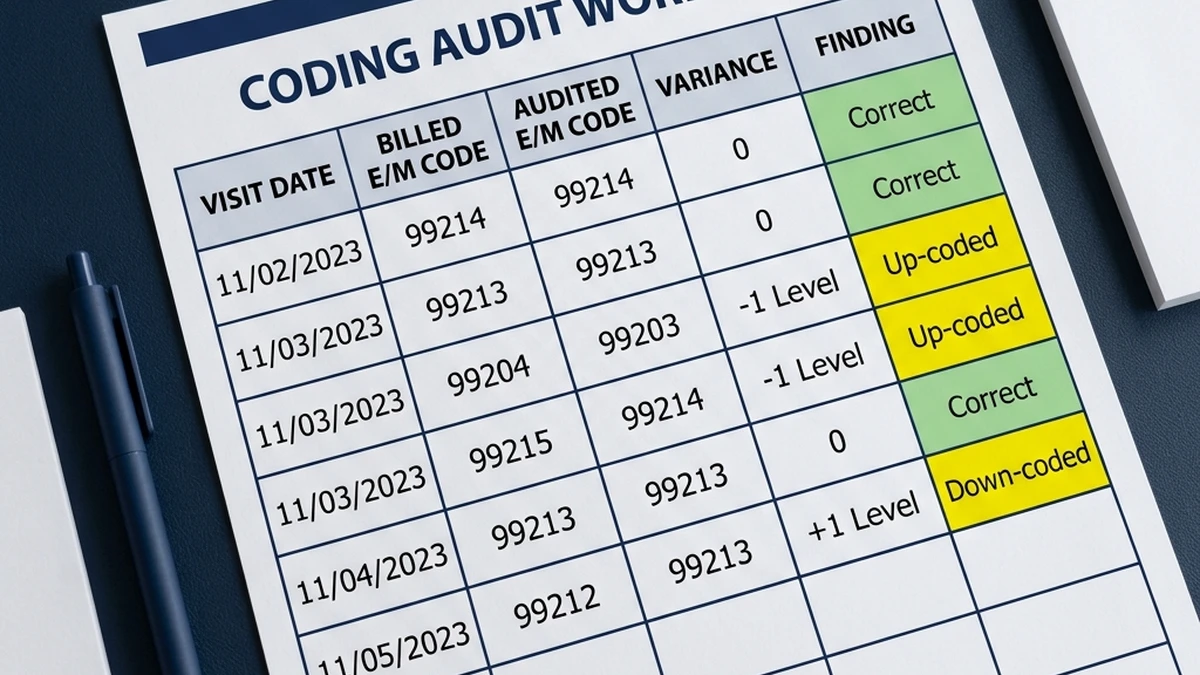
A coding audit compares what the record documents against what was coded and billed. It identifies both overcoding exposure and the undercoding that quietly reduces revenue, then reports the patterns rather than just the individual errors.
- Documentation compared against the codes actually submitted
- Overcoding exposure and undercoding loss both identified
- Patterns reported by provider and code family
- Findings turned into specific documentation guidance
Medical Coding Audit Explained
A medical coding audit is a structured review of coded claims against the underlying clinical documentation to assess accuracy, compliance, and completeness. It identifies under-coding, over-coding, unsupported code assignments, and documentation deficiencies that affect both revenue and compliance exposure. Coding audits can be pre-bill (prospective) to catch errors before submission or retrospective to assess historical coding patterns. For a broader evaluation that also covers billing workflows, see our revenue cycle audit.
Medsure RCS conducts coding audits as both standalone engagements and as part of ongoing monthly coding quality programs. Our findings are tied directly to documentation and specific coding guidelines, not general observations, so providers and coders understand exactly what needs to change and why. Audit results feed directly into our medical coding compliance program and, where appropriate, into denial management workflows to recover under-coded claims within filing windows. Coding audit results inform a parallel medical billing audit to address downstream billing errors that originate at the coding level.
How It Works: Step by Step
Audit Sample Selection
A representative sample of claims is selected by date range, provider, service type, or payer depending on audit objectives and risk areas.
Documentation vs. Code Comparison
Each claim's CPT, ICD-10-CM, and modifier selections are compared against the clinical documentation to verify support for each code assigned.
Error Categorization and Rate Calculation
Identified errors are categorized by error type and code, and error rates are calculated by provider, service type, and code category.
Audit Report and Education Plan
Results are compiled into a coder-level and provider-level report with specific findings, a calculated error rate, and a coding education plan.
The Impact of Accurate Coding
Industry standard for coding accuracy is 95 percent or above; our audits measure and track progress toward this benchmark.
Pre-bill audits catch errors before they reach payers, preventing denials and compliance issues.
Audit findings are reported per individual coder to target education where it is actually needed.
Audits identify under-coded claims where additional revenue can be recovered through corrected submissions.
Common Mistakes in Medical Coding Audit
Auditing Only High-Level Codes for Over-Coding
One-sided audits that look only for over-coded visits miss under-coding, which is equally problematic for revenue. A complete coding audit must assess accuracy in both directions.
Not Providing Specific Guideline References in Findings
Audit findings that identify errors without citing the specific coding guideline, LCD, or documentation requirement that was violated give coders no actionable information for improvement.
Auditing Once Annually Without Ongoing Monitoring
An annual audit reveals where coding was in the past. Quarterly or monthly spot audits with rapid feedback loops are needed to maintain coding quality and catch emerging problems before they accumulate.
Using Audit Results to Penalize Rather Than Educate
Coders who fear punitive consequences for audit findings are less likely to ask questions or raise uncertainty about difficult code assignments. Audit programs must be positioned as quality improvement tools, not performance management instruments.
How Medsure RCS Manages Medical Coding Audit
Pre-Bill Prospective Audits
We review coded claims before submission to catch errors while they are still correctable, preventing denials and eliminating the need for corrected claim submissions.
Retrospective Accuracy Assessment
Historical claim samples are audited against documentation to assess overall accuracy rates, identify patterns, and calculate revenue impact of identified errors.
Coder and Provider Performance Reports
Findings are reported at the individual coder and provider level with specific error rates, error type breakdowns, and targeted education recommendations.
Coding Education Program Development
Audit findings feed into a structured coding education plan with targeted learning resources for identified error types, specialty-specific guidelines, and documentation improvement recommendations.
Related Services
Medical Coding Audit, Frequently Asked Questions
Best practice is a pre-bill sample audit monthly for each coder and a comprehensive retrospective audit at least annually. Practices with new coders, high denial rates, or recent payer focus should audit more frequently.
Industry standards suggest a target accuracy rate of 95 percent or above. An error rate above 5 percent indicates systemic coding problems that require immediate education and process correction.
Yes. Under-coding is as common as over-coding and is identified by comparing coded levels against documentation-supported levels. Audits often find significant revenue recovery opportunities through corrected submissions for under-coded claims still within filing windows.
A coding error means a wrong code was selected despite adequate documentation. A documentation deficiency means the documentation does not support the level of specificity or complexity the provider intended to bill. Both require correction, but the corrective action is different.
Ask About Medical Coding Audit
Ready to Improve Your Medical Coding Audit?
Talk to a Medsure RCS specialist. No commitment, no pressure, just answers.
Sign up for our newsletter to receive updates, industry news, and articles about medical billing and revenue cycle management.