

Medicare Provider Credentialing
Medicare credentialing and PECOS enrollment management for new and re-enrolling providers. Accurate applications and tracking to prevent billing gaps.
How Medicare Enrollment Works
Medicare enrollment runs through PECOS and requires accurate, consistent information across every field. Applications are commonly delayed by discrepancies that seem minor, and the effective date determines how far back the provider can legitimately bill.
- PECOS applications prepared with consistent, verified information
- Revalidation deadlines tracked so enrollment does not lapse
- Effective dates confirmed before billing begins
- Reassignment and group affiliations recorded correctly
Medicare Provider Credentialing Explained
Medicare provider credentialing is the process of enrolling a provider in the Medicare program through the Provider Enrollment, Chain, and Ownership System (PECOS) or via the paper CMS-855 application series. Without an approved Medicare enrollment, providers cannot bill Medicare Part B for professional services or receive payment for Medicare patients, even if the services are medically appropriate and perfectly coded, creating a direct gap in accounts receivable.
Medsure RCS manages the Medicare enrollment process from NPI verification through PECOS submission, application review, and approval confirmation. We track every submitted application through CMS processing timelines and follow up proactively to prevent the delays that commonly occur when applications stall without a dedicated tracking process, supporting uninterrupted medical billing for every enrolled provider. PECOS enrollment is required to bill under Medicare billing and is managed alongside Medicaid credentialing as part of our provider credentialing program.
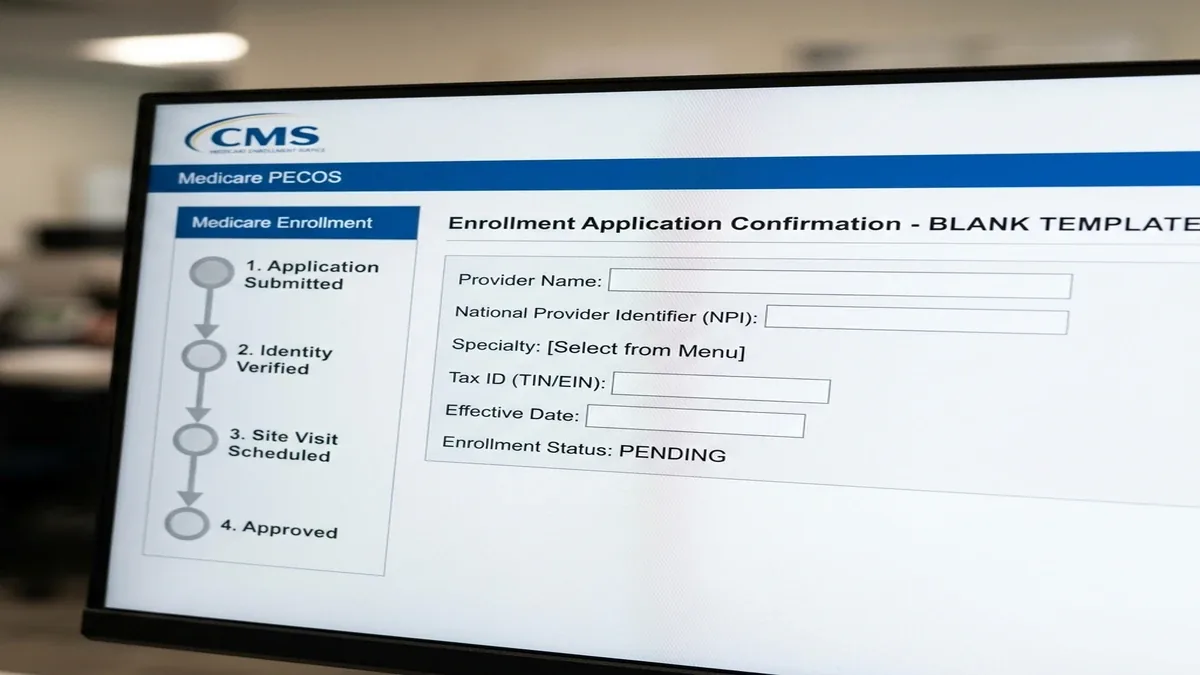
How It Works: Step by Step
We verify the provider's NPI (Type 1) and confirm the correct specialty taxonomy code is selected for the type of Medicare enrollment being submitted.
The PECOS internet-based enrollment application is prepared with complete provider information, practice location details, and reassignment of benefits documentation.
Required supporting documents including license copies, voided check for EFT, and any surety bonds are compiled and submitted with the application.
Submitted applications are tracked through the MAC's processing queue with proactive follow-up calls and PECOS status checks to prevent processing delays.
Why This Matters for Your Revenue Cycle
Medicare enrollments typically complete within 30 to 60 days with a complete, accurate application.
PECOS electronic applications process faster than paper CMS-855 submissions.
All Medicare applications are reviewed for completeness before submission to prevent development requests.
Electronic Funds Transfer enrollment is completed simultaneously to enable direct deposit of Medicare payments.
Common Mistakes in Medicare Provider Credentialing
Incorrect Taxonomy Code Selection
Medicare enrollment requires the correct specialty taxonomy code for the provider's type of practice. Using the wrong taxonomy results in enrollment in the wrong specialty category, which can affect payment rates and coverage determinations.
Missing Reassignment of Benefits Documentation
When a provider reassigns Medicare benefits to a group practice, the reassignment documentation must be included in the enrollment application. Missing this documentation results in payments going to the wrong entity or application development requests.
Not Setting Up EFT During Enrollment
Medicare pays by EFT (direct deposit) by default. Practices that do not establish their EFT banking information during enrollment face delays in receiving payments while paper check enrollment is processed separately.
Not Responding to Development Requests Promptly
When CMS has questions about an enrollment application, they issue a development request with a response deadline. Missing the response deadline results in application denial and requires restarting the enrollment process.
How Medsure RCS Manages Medicare Provider Credentialing
PECOS Internet Enrollment Management
We prepare and submit all Medicare enrollment applications through PECOS with complete, consistent information verified against NPI registry and CAQH data.
CMS-855 Paper Application Support
For enrollment types that require the paper CMS-855 series, we prepare and submit complete applications with all required attachments.
Development Request Response
When CMS issues development requests during processing, we respond promptly with the requested information or clarification to prevent application denial.
Revalidation Tracking
Medicare requires revalidation every five years. We track revalidation deadlines and submit applications in advance to prevent enrollment lapses.
Medicare Provider Credentialing, Frequently Asked Questions
PECOS (Provider Enrollment, Chain and Ownership System) is CMS's internet-based enrollment platform. CMS-855 refers to the paper application forms used for Medicare enrollment. Most enrollments can be completed through PECOS, which processes faster than paper applications.
CMS requires all enrolled providers to revalidate (confirm continued enrollment) every five years for most provider types. Revalidation requests are sent by the MAC. Providers who do not respond to revalidation requests have their enrollment deactivated and lose the ability to bill Medicare.
No. Medicare requires an active enrollment before claims can be submitted. Some exceptions exist for providers joining an existing enrolled group under specific circumstances, but these are limited. Most new providers must wait for enrollment approval before seeing Medicare patients whose services will be billed.
Providers can opt out of Medicare entirely rather than enrolling. Opted-out providers do not submit Medicare claims and bill patients directly under private contracts. Opting out is a formal process with CMS and has specific rules and limitations. Most providers enroll rather than opt out.
Ask About Medicare Provider Credentialing
Ready to Improve Your Medicare Provider Credentialing?
Talk to a Medsure RCS specialist. No commitment, no pressure, just answers.
Sign up for our newsletter to receive updates, industry news, and articles about medical billing and revenue cycle management.