
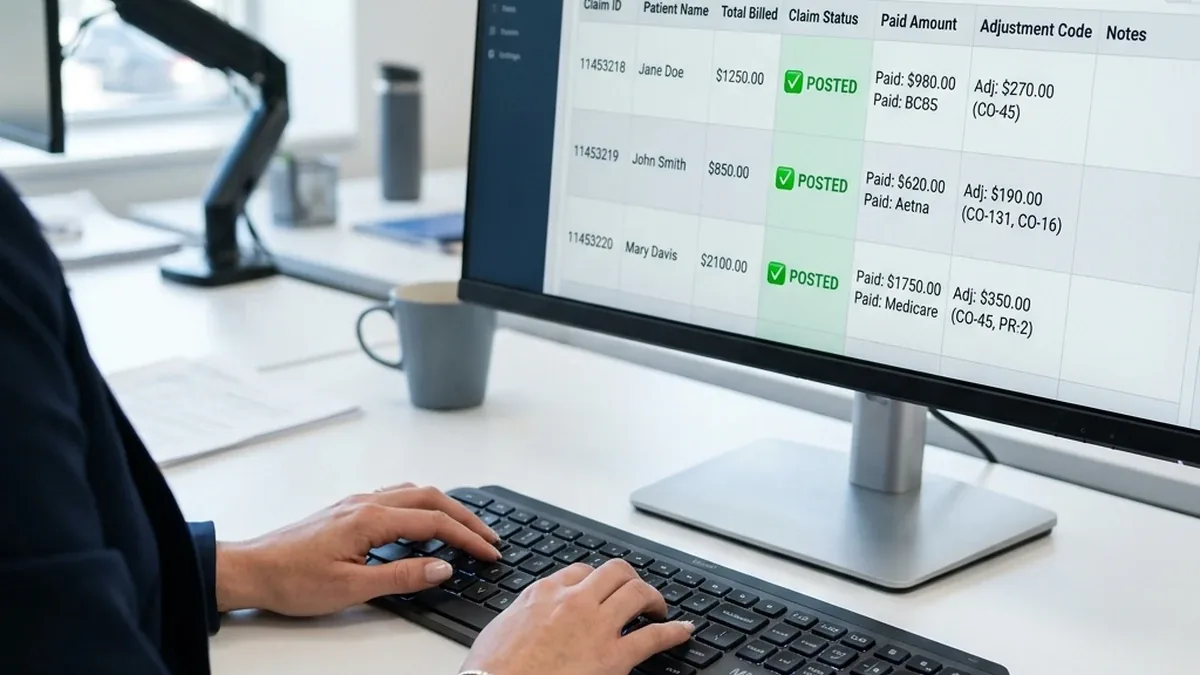
Payment Posting Services
Accurate payment posting including ERA/EOB reconciliation, contractual adjustment verification, and identification of underpayments across all payer types.
Why Payment Posting Is More Than Data Entry
Posting is where underpayments are caught or missed. Remittances posted against the expected contract rate rather than the billed amount reveal a payer paying below its own fee schedule in the same cycle, instead of months later when the pattern is expensive.
- Payments posted against contracted rates, not just billed charges
- Underpayments identified in the cycle they occur
- Adjustments coded correctly as contractual, patient or payer initiated
- Unposted and mismatched payments reconciled daily
Payment Posting Explained
Payment posting is the process of applying payments received from insurance payers and patients to the correct accounts in the billing system. It includes posting electronic remittance advices (ERAs) and manual explanations of benefits (EOBs), applying contractual adjustments, identifying underpayments, and routing balances to secondary payers or patient responsibility accounts correctly. CMS ERA standards require that posted contractual adjustments reflect the actual contracted rate, not whatever write-off amount the payer suggests.
Accurate payment posting is critical because it is the foundation of accounts receivable management. Every number in your AR report, every payer underpayment identified, and every patient balance generated depends on payment posting being done correctly and consistently. Underpayments flagged during posting feed directly into billing follow-up workflows so they are recovered rather than silently written off. Payments below the contractual amount or accompanied by denial codes are escalated to denial management for review and recovery.
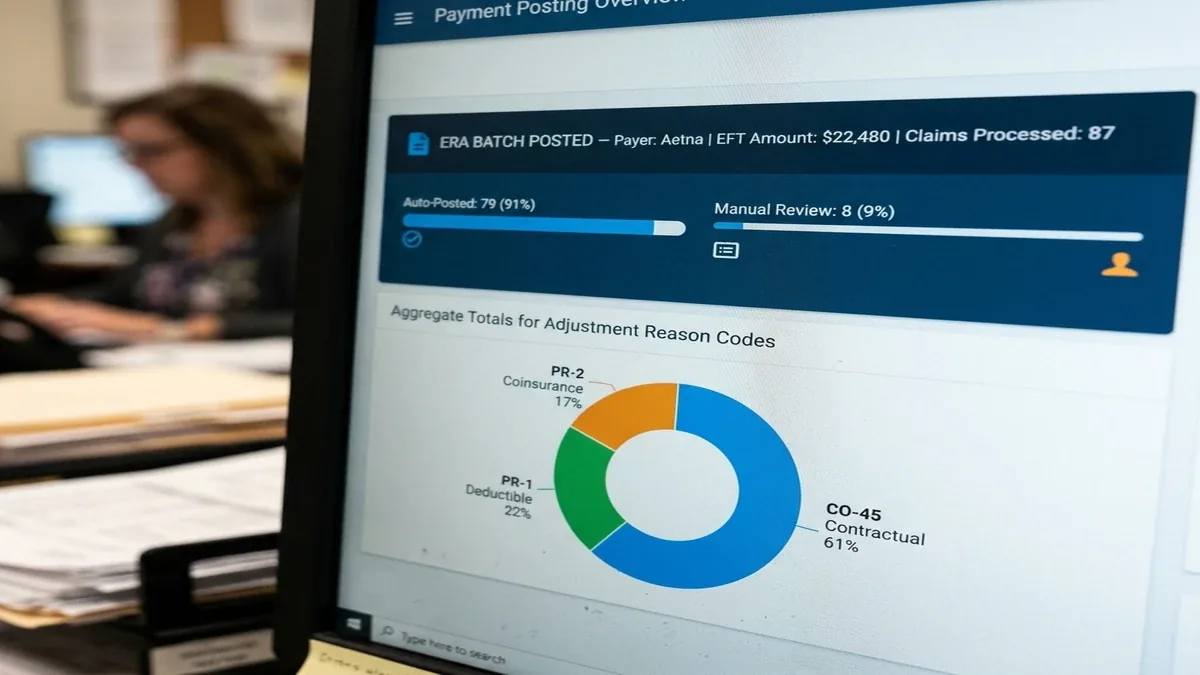
How It Works: Step by Step
ERA and EOB Receipt
Electronic remittance advices (835 files) are received daily and matched to outstanding claims. Manual EOBs are scanned and processed as they arrive.
Payment Application
Payments are applied to the correct claim lines with accurate contractual adjustments, write-offs, and patient balance transfers.
Underpayment Identification
Posted amounts are compared against contracted fee schedules to identify payers paying below the contracted rate, which triggers a follow-up or dispute workflow.
Balance Routing
Remaining balances after primary insurance posting are correctly routed to secondary insurance or patient responsibility with the appropriate claim or statement generated.
Why This Matters for Your Revenue Cycle
Electronic remittances are processed the same business day they are received to keep AR current.
All adjustments are applied per contracted fee schedules, not based on whatever the payer sends.
AR balances are updated daily after payment posting so aging reports reflect current status.
Payer underpayments are flagged and tracked for follow-up, not silently written off.
Common Mistakes in Payment Posting
Accepting Whatever the Payer Posts Without Checking the Fee Schedule
Payers sometimes pay below the contracted rate without explanation. Posting whatever amount arrives without comparing it to the contracted fee schedule causes the underpayment to be written off instead of recovered.
Applying Payments to Wrong Claim Lines
When a payment is applied to the wrong claim line, the actual claim line remains open as an outstanding balance, inflating AR and triggering unnecessary follow-up work.
Batching EOBs and Posting in Bulk Without Daily Reconciliation
Posting EOBs in bulk batches rather than daily prevents the AR report from reflecting current status, making it impossible to identify stalled claims or aging issues accurately.
Not Routing Remaining Balances to Secondary Insurance
After primary insurance pays, the remaining balance must be routed to the secondary payer before going to the patient. Sending patient statements before secondary insurance has been billed is premature and incorrect.
How Medsure RCS Manages Payment Posting
Daily ERA 835 Processing
All electronic remittances are processed daily as they arrive, keeping AR balances current and providing daily visibility into cash receipts.
Fee Schedule Variance Identification
Every posted payment is compared against the contracted fee schedule and flagged if the payer paid below the contracted amount.
Contractual Adjustment Management
We apply contractual adjustments based on contracted rates, not on whatever write-off amount the payer suggests, preventing revenue from being written off incorrectly.
Secondary Payer Routing
After primary insurance posting, remaining balances are correctly routed to secondary insurance with crossover claims or coordination of benefits documentation as required.
Payment Posting, Frequently Asked Questions
An ERA (Electronic Remittance Advice) is the electronic version of a payment explanation, delivered as a standardized 835 transaction file. An EOB (Explanation of Benefits) is the paper or PDF equivalent. Both explain what was paid, what was adjusted, and what remains due, but ERAs can be auto-posted while EOBs require manual entry.
We compare the posted payment amount for each claim line against the contracted fee schedule for that payer and service code. Any payment below the contracted rate is flagged as an underpayment and queued for follow-up.
Payment posting errors are identified through our daily reconciliation process. When a misposting is found, we reverse and repost the payment correctly and investigate whether the error was isolated or part of a pattern.
Electronic remittances are processed the same business day. Manual EOBs are posted within one to two business days of receipt depending on volume.
Ask About Payment Posting
Ready to Improve Your Payment Posting?
Talk to a Medsure RCS specialist. No commitment, no pressure, just answers.
Sign up for our newsletter to receive updates, industry news, and articles about medical billing and revenue cycle management.