

Prior Authorization Services
Prior authorization management that tracks payer requirements, submits authorizations proactively, and reduces claim denials from missing approvals.
How Prior Authorization Failures Cost Revenue
An authorization obtained after the service is delivered rarely rescues the claim. The work has to happen before the encounter: identifying which services require approval for that specific plan, submitting with clinical support, and tracking the response before the date of service.
- Authorization requirements identified per plan, not per service type
- Requests submitted with the clinical documentation the payer requires
- Status tracked to decision before the appointment date
- Denied authorizations escalated to peer review while there is still time
Prior Authorization Services Explained
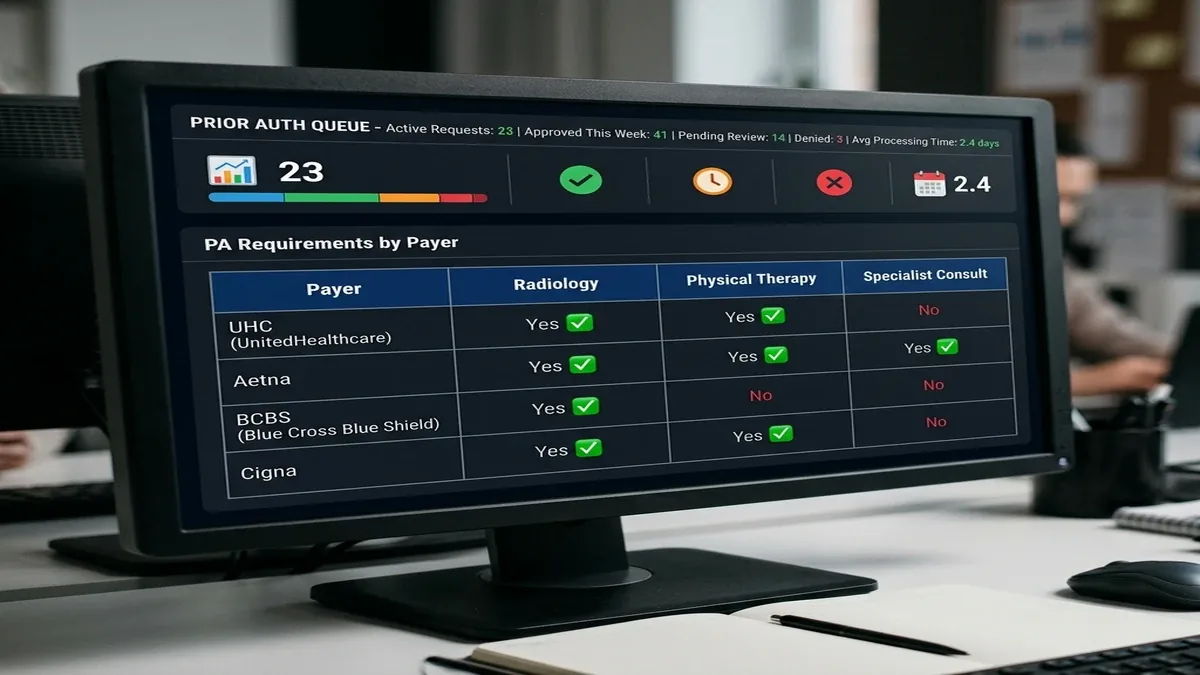
Prior authorization (PA) is the process of obtaining advance approval from a patient's insurance payer before providing specific procedures, services, or medications. Without an approved PA, claims for those services are denied on medical necessity or authorization grounds, and reversal is often difficult regardless of clinical appropriateness. CMS has established interoperability rules requiring payers to respond to PA requests within defined timeframes, but tracking those timelines still falls on the provider's billing team.
Medsure RCS manages prior authorization workflows from initial request through final approval tracking. We track payer-specific PA requirements, submit requests proactively, follow up within payer timelines, and manage peer-to-peer reviews when requests are initially denied. PA denials that cannot be reversed through appeal are escalated through our prior auth denial management process to maximize recovery. PA management runs parallel to insurance eligibility verification and is especially intensive in specialty medical billing contexts. When an authorization is missing, expired or does not match the service billed, the claim returns as CO-15.
How It Works: Step by Step
PA Requirement Identification
At the time of scheduling, we identify whether the planned service requires prior authorization based on the patient's specific payer and plan.
Authorization Request Submission
PA requests are submitted with complete clinical supporting documentation through payer portals or fax systems within the required lead time.
Follow-Up and Status Tracking
Submitted PAs are tracked daily through payer portals and by phone until a determination is received, with escalation for requests approaching the service date.
Denied PA Appeal
When authorization is denied, we review the denial reason, gather additional clinical documentation, and submit a written appeal or arrange a peer-to-peer physician review.
Why This Matters for Your Revenue Cycle
PA requests are submitted at least 48 hours before the scheduled service date.
Every scheduled service is checked against the payer's current authorization requirements.
When a PA is denied, we begin the appeal process the same day the denial is received.
Approved authorizations are tracked for expiration dates so services are scheduled within the authorized window.
Common Mistakes in Prior Authorization Services
Requesting Authorization Too Late
Submitting a PA request on the day of service or the day before gives no time to respond if the payer has questions or requests additional documentation. Requests should be submitted at least several days before the scheduled service.
Submitting Incomplete Clinical Documentation
PA requests submitted without adequate supporting clinical documentation are denied for insufficient information. Every request must include the clinical notes, diagnosis history, and prior treatment records the payer requires for that service type.
Not Tracking Approved PA Expiration Dates
Approved authorizations have validity windows. Services rendered after an authorization expires are treated as unauthorized, the same as if no authorization had been obtained.
Not Pursuing Peer-to-Peer Review on Denials
Many initial PA denials can be reversed through a peer-to-peer call between the treating physician and the payer's medical director. Not requesting this option when available leaves recoverable authorizations unclaimed.
How Medsure RCS Manages Prior Authorization Services
Payer-Specific PA Requirement Tracking
We maintain current PA requirement lists for all major payers and apply the correct rules to each patient encounter at the time of scheduling.
Clinical Documentation Compilation
We gather the clinical notes, diagnosis history, and supporting records required by each payer's specific PA criteria before submitting the request.
Daily Status Follow-Up
Outstanding PA requests are followed up daily through payer portals and phone to prevent delays from sitting unresolved near the service date.
Peer-to-Peer Coordination
When a PA is denied and a peer-to-peer review is appropriate, we coordinate the scheduling and documentation support for the treating physician's call with the payer's medical director.
Prior Authorization Services, Frequently Asked Questions
PA requirements vary by payer and plan, but commonly include advanced imaging (MRI, CT), elective surgical procedures, specialist referrals in HMO plans, high-cost medications, and durable medical equipment. Requirements change frequently and must be verified for each patient's specific plan.
The claim will be denied for lack of authorization. Some payers allow retroactive authorization requests in limited circumstances, but these are rarely approved unless there was a documented urgent or emergent situation.
Routine PA requests are typically decided within 3 to 5 business days. Urgent requests may be processed within 24 to 72 hours. Timelines vary significantly by payer and service type.
Yes. PA denials can be appealed in writing with additional clinical documentation, or through a peer-to-peer review where the treating physician speaks directly with the payer's medical director. Success rates vary by denial reason and payer.
Ask About Prior Authorization Services
Ready to Improve Your Prior Authorization Services?
Talk to a Medsure RCS specialist. No commitment, no pressure, just answers.
Sign up for our newsletter to receive updates, industry news, and articles about medical billing and revenue cycle management.