
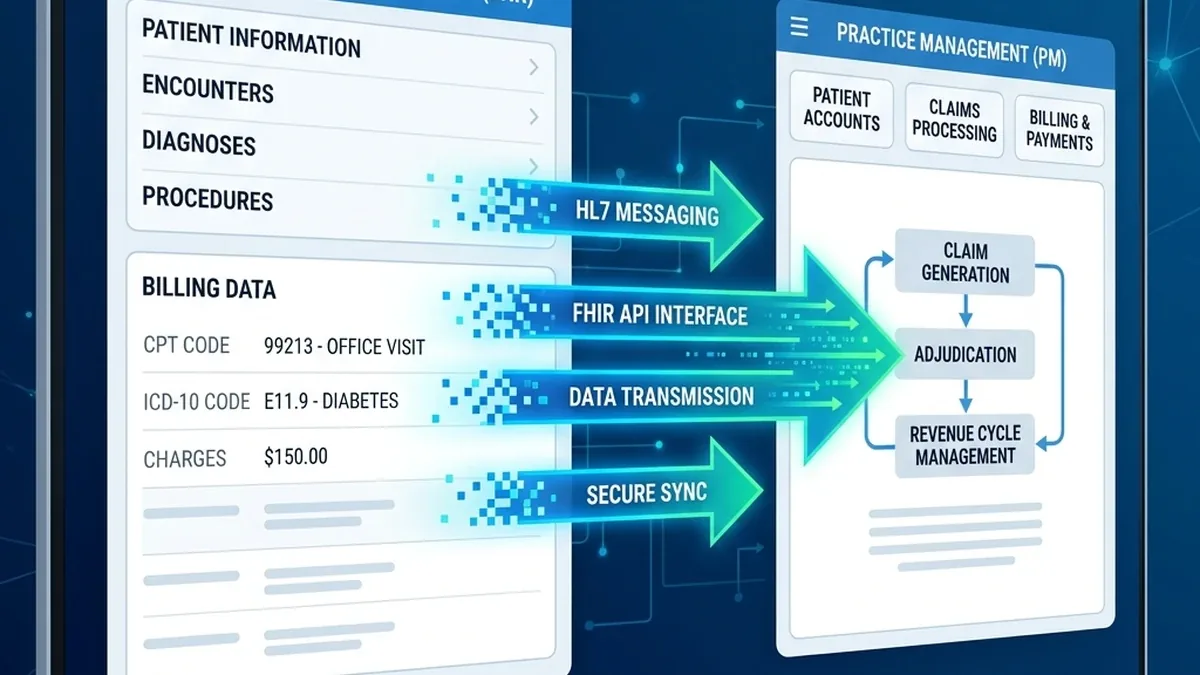
The EHR system and the billing system are two of the most important technology platforms a medical practice operates. When they communicate well, clinical documentation flows into the billing workflow cleanly, reducing manual data entry, coding errors, and claim preparation time. When they do not integrate well, staff spend hours re-entering information and the billing cycle slows down.
Understanding how EHR and practice management system integration affects billing is important both for practices evaluating new systems and for practices working with an outside billing company. If the integration is not set up correctly, the billing relationship will underperform regardless of how competent the billing team is.
What EHR Integration Means in a Billing Context
In a fully integrated workflow, the EHR captures the clinical encounter, coding is applied within the EHR, and the resulting charge is passed electronically to the practice management system for claim preparation and submission. Patient demographic information, insurance data, and appointment history are shared between systems without manual re-entry. Our medical billing services work within your existing EHR environment without requiring system changes.
Common Integration Challenges
- Charge capture gaps: Procedures documented in the EHR that never make it to the claim because the charge interface is misconfigured, identified through a medical billing audit.
- Demographic mismatches: Patient information updated in one system but not the other, leading to claim errors caught through eligibility verification.
- Code set synchronization: EHR code libraries not updated to current CPT or ICD-10-CM versions produce incorrect codes on charges.
- Duplicate patient records: Multiple records for the same patient creating claim routing errors.
- Authorization tracking: PA data managed in the EHR but not accessible to the billing system, causing authorization number gaps on claims.
What to Verify Before Working With a Billing Company
Before engaging an outside billing company, confirm that they can access your EHR or practice management system. Ask whether they use direct EHR access, file exports, or a third-party integration tool. Confirm the frequency of data transfer: real-time is ideal; daily batch is acceptable. Verify that the billing company reconciles charges against the appointment schedule to catch missed charges. Our revenue cycle management onboarding process includes a full integration audit before the first claim is submitted.
Key Takeaways
- EHR and practice management integration quality directly affects billing accuracy and claim speed.
- Charge capture gaps are one of the most common and least visible sources of revenue leakage.
- Verify EHR access and data transfer frequency before signing with an outside billing company.
- ICD-10-CM and CPT code library updates in the EHR must be kept current to avoid stale codes.
- Demographic data must be synchronized between EHR and billing systems to prevent eligibility denials.
Frequently Asked Questions
Do billing companies need direct access to the EHR?
Not necessarily. Many billing companies work through the practice management system. What matters is that charge data, demographic information, and insurance information flow reliably from the practice to the billing company. Our medical billing services support multiple data transfer methods.
What is a practice management system and how is it different from an EHR?
An EHR manages clinical documentation, including visit notes, orders, and test results. A practice management system manages the business functions: scheduling, billing, patient accounts, and reporting. The quality of the interface between them is critical to billing performance.
How do you identify a charge capture problem?
Compare the number of appointments completed in a period against the number of claims submitted for that same period. A consistent gap indicates that charges are not being captured for every encounter. Our medical billing audit includes a charge capture reconciliation as part of its standard review.