
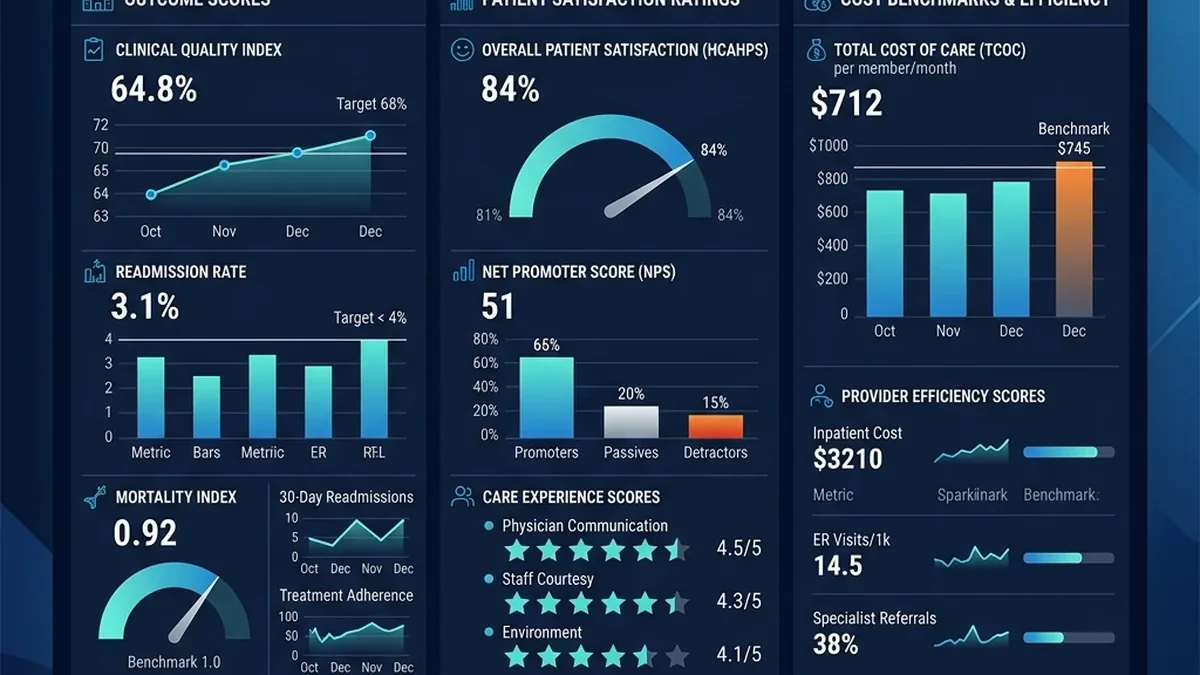
Value-based care payment models tie provider reimbursement to clinical outcomes and quality measures rather than purely to the volume of services delivered. These models have grown significantly in Medicare and are increasingly common in commercial payer contracts. Our MIPS consulting services support practices operating under both MIPS and Advanced APM models.
Understanding how value-based arrangements affect billing is important for any practice that participates in Medicare Advantage, an Accountable Care Organization (ACO), or any commercial risk-sharing contract. Clinical documentation quality directly determines financial performance in all of these models.
Common Value-Based Payment Models
- Pay-for-Performance (P4P): Quality bonuses or penalties applied to standard fee-for-service payments based on measured outcomes.
- Shared Savings: Providers share in savings when total cost of care falls below a benchmark; ACOs under Medicare Shared Savings Program (MSSP) operate this way.
- Bundled Payments: A single payment covers all services related to an episode of care, see CMS Bundled Payments for Care Improvement (BPCI).
- Capitation: A per-member per-month payment covers all care for an attributed population, common in Medicare Advantage and Medicaid managed care.
- Advanced APMs: CMS models that qualify clinicians for QPP bonus payments in place of MIPS reporting.
How Risk Adjustment Affects Billing in Value-Based Care
In capitated and shared savings arrangements, payments are adjusted based on the risk profile of the attributed patient population. HCC (Hierarchical Condition Category) coding captures chronic conditions and comorbidities that drive risk scores. If a patient has multiple chronic conditions that are not documented and captured in claim codes, the practice is being paid for a healthier patient than it is actually treating. Our medical coding services include HCC capture review for value-based contracts.
Documentation Requirements for Value-Based Billing
Annual wellness visits and Chronic Care Management (CCM) services play a central role in value-based billing because they create the documentation opportunities to capture current conditions and generate the codes that drive risk adjustment. CCM is billed using CPT codes 99490 (first 20 minutes), 99439 (each additional 20 minutes), and 99487 (complex CCM) per month. Our revenue cycle management program includes CCM billing setup and monthly tracking.
Key Takeaways
- Value-based models tie reimbursement to outcomes, not just service volume.
- HCC coding accuracy directly affects capitation payments and shared savings calculations.
- Annual wellness visits and Chronic Care Management services are core value-based billing opportunities.
- Documentation specificity matters more in value-based care than in fee-for-service billing.
- Practices in Medicare Advantage contracts should audit HCC capture annually before the risk adjustment deadline.
Frequently Asked Questions
What is an HCC code?
Hierarchical Condition Categories (HCCs) are groupings of related ICD-10-CM diagnosis codes used by CMS to calculate risk scores for Medicare Advantage and other risk-adjusted payment models. Our medical coding services optimize HCC capture for value-based contracts.
Does participating in an ACO change how claims are submitted?
No. Claims are still submitted to Medicare in the standard 837 format. ACO performance is measured at the population level using the claims data.
What is Chronic Care Management billing?
Chronic Care Management (CCM) is a billable service for patients with two or more chronic conditions using CPT codes 99490, 99439, and 99487 per month. Our revenue cycle management program includes CCM billing setup and monthly documentation tracking.