

Urgent Care Billing Services
Urgent care billing services that manage high-volume claim processing, facility vs professional fee billing.
What Makes Urgent Care Billing Different
Urgent care runs high unscheduled volume with a payer mix that shifts daily, and payers apply their own rules to the place of service code. Claims need same-day submission at volume, with procedures performed during the visit captured rather than left in the narrative.
- Place of service applied correctly so cost-sharing is adjudicated right
- Facility and professional components separated where the centre bills both
- Procedures during the visit abstracted onto the claim, not lost in the note
- Same-day submission cadence to match unscheduled patient volume
Urgent Care Billing Services Explained
Urgent care billing involves high-volume claim processing, correct facility vs professional fee billing decisions, and payer-specific urgent care policies that affect coverage and reimbursement. Place of service code 20 is required by CMS for urgent care centers, some payers apply different cost-sharing to urgent care visits versus emergency department visits based on this code. Groups billing the hospital side of that distinction are covered under emergency medicine billing.
Medsure RCS manages urgent care medical billing services for Florida centers with workflows built for high daily volume and rapid turnaround. We handle correct E/M coding, charge capture for urgent care-level interventions, and payer-specific urgent care plan rules to maximize clean claim rates. Urgent care is part of our specialty medical billing program. Some plans pay a global per visit fee under S9083 instead of the individual services billed.
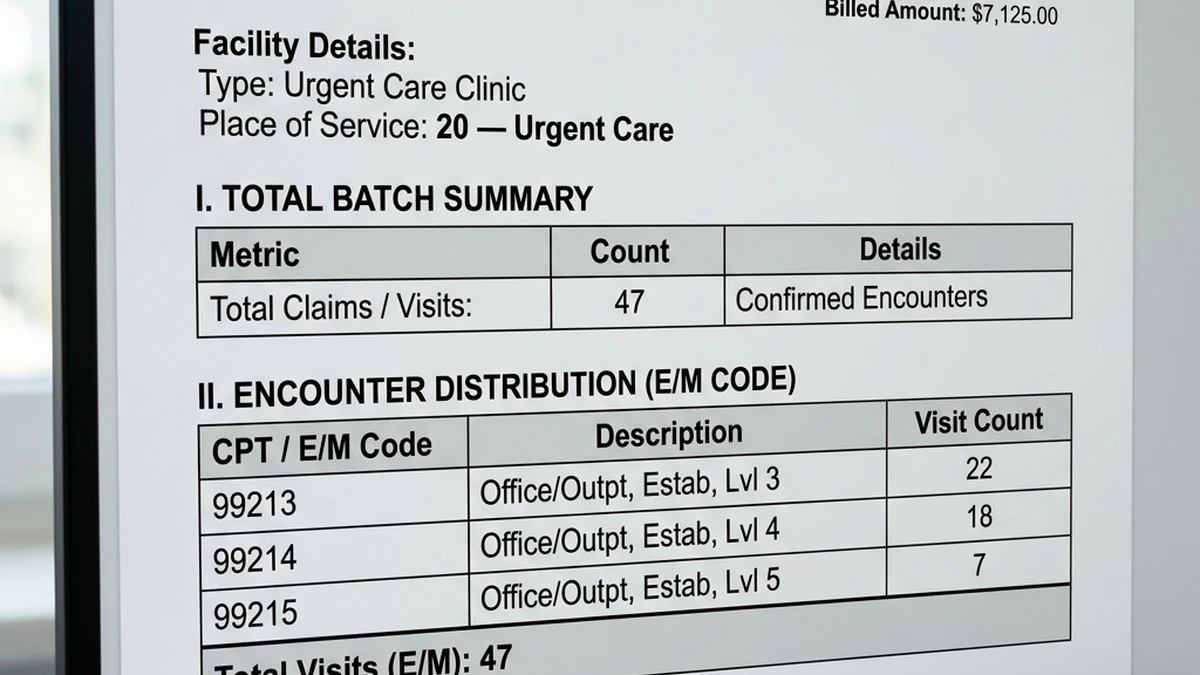
How It Works: Step by Step
E/M Level Coding
Visit documentation is reviewed to determine the correct E/M level using Medical Decision Making or time-based criteria per 2024 AMA guidelines.
Place of Service Assignment
Claims are submitted with correct place of service code 20 (urgent care) for urgent care center visits, distinguishing from POS 11 (office) and POS 23 (emergency room).
Procedure Billing
Laceration repairs, fracture splinting, joint injections, and other urgent care procedures are billed separately from the E/M with correct code selection and documentation.
High-Volume Submission Processing
Daily encounter batches are processed, coded, and submitted within 24 hours of encounter documentation to maintain rapid revenue cycle turnover.
Why This Matters for Your Revenue Cycle
Daily encounter batches are coded and submitted within 24 hours of signed documentation receipt.
Urgent care E/M accuracy and POS code compliance drive first-pass acceptance above 95%.
Place of service code 20 (urgent care) is applied consistently to prevent reimbursement rate discrepancies.
All urgent care procedures are billed separately with correct code selection alongside the E/M.
Common Mistakes in Urgent Care Billing Services
Wrong Place of Service Code
Urgent care centers operate under POS 20. Using POS 11 (physician office) or POS 23 (ER) results in incorrect cost-sharing application and reimbursement rate calculation by payers. This is a consistent systemic error in urgent care billing.
Undercoding E/M Level for Complex Visits
Urgent care visits frequently involve multiple problems, diagnostic interpretation, and clinical decision-making that supports a higher E/M level. Defaulting to a level 3 visit for all patients results in systematic revenue loss for visits that legitimately qualify for level 4 or 5.
Missing Procedure Code With E/M
Procedures performed at urgent care visits (laceration repair, IV infusion, I&D, splinting) are separately billable from the E/M. Failing to bill the procedure separately or bundling it into the E/M without a procedure code leaves significant procedure revenue uncollected.
Inconsistent Documentation Across Providers
Urgent care centers with multiple providers often have documentation inconsistencies that affect E/M level accuracy. Without systematic documentation standards, coding accuracy varies by provider, creating uneven revenue capture.
How Medsure RCS Manages Urgent Care Billing Services
High-Volume E/M Coding
Rapid, accurate E/M coding for urgent care visit volume with MDM-based level selection per 2024 AMA guidelines.
Procedure Billing
Laceration repair, I&D, fracture splinting, joint injection, and other urgent care procedure billing alongside the E/M visit.
Place of Service Management
POS code 20 applied consistently across all urgent care claims to ensure correct reimbursement rates and cost-sharing.
Workers Compensation Billing
Workers compensation claim handling with employer case number, treating physician authorization, and state fee schedule rates.
Occupational Health Billing
Pre-employment physicals, drug screens, and occupational health screenings billed correctly to employer accounts.
Diagnostic Testing Billing
In-house X-ray, point-of-care testing, and laboratory billing from urgent care encounters with correct technical and professional billing.
Urgent Care Billing Services, Frequently Asked Questions
Urgent care centers use POS 20. This distinguishes the encounter from a physician office visit (POS 11) and an emergency department visit (POS 23). The POS code affects cost-sharing under many insurance plans, so correct assignment is important for accurate patient liability and provider reimbursement.
When the urgent care center owns the X-ray equipment, the technical component is billed by the facility. When a radiologist interprets the film, the professional component (modifier 26) is billed by the radiologist. When the urgent care physician interprets the film themselves, the global code is billed without modifiers.
Yes. When a separately identifiable E/M is performed beyond the minor procedure, modifier 25 is applied to the E/M code. The laceration repair code is billed at the full rate. For simple lacerations where the E/M is part of the procedure decision, only the repair code is billed.
Workers compensation billing requires the employer's case number, the claim adjuster information, and compliance with the applicable state fee schedule. Florida workers compensation follows the Florida Workers Compensation fee schedule, which differs from standard payer rates. We apply these rates correctly and submit to the correct payer.
Ask About Urgent Care Billing Services
Ready to Improve Your Urgent Care Billing Services?
Talk to a Medsure RCS specialist. No commitment, no pressure, just answers.
Sign up for our newsletter to receive updates, industry news, and articles about medical billing and revenue cycle management.