

Oncology Billing Services
Oncology billing services for chemotherapy administration, infusion therapy, radiation oncology, and oncology E/M.
Why Oncology Billing Is High Risk
Oncology combines high-cost drugs with complex administration rules, so the cost of an error is unusually large. Drug units, administration hierarchy and infusion timing all have to match the documented treatment record.
- Drug units billed to match what was documented as administered
- Infusion hierarchy applied to initial, sequential and concurrent services
- Authorization confirmed before treatment begins
- Wastage documented and reported where the payer permits
Oncology Billing Services Explained
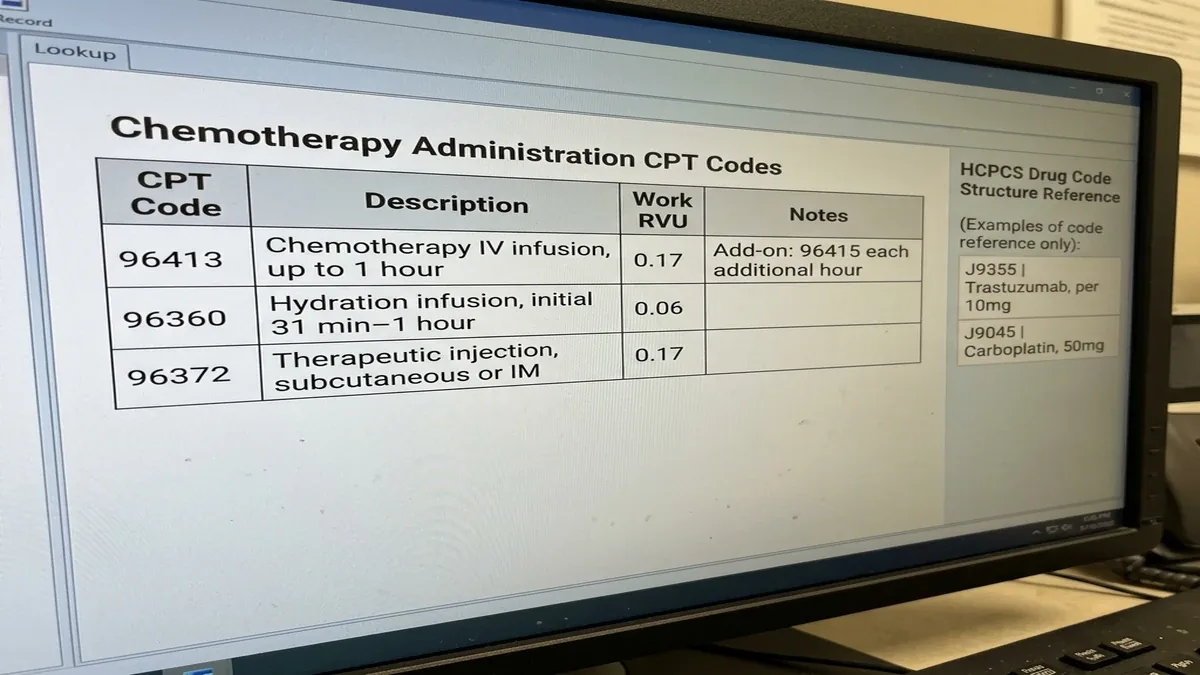
Oncology billing involves chemotherapy administration coding, biologic drug HCPCS J-code billing, infusion hierarchy rules, and high prior authorization volumes for expensive cancer treatments. Chemotherapy administration codes follow an infusion hierarchy governed by CMS Medicare billing policy where each drug is classified as the primary infusion, a sequential infusion, or a concurrent infusion, each with different reimbursement levels.
Medsure RCS manages oncology medical billing services for medical oncology, radiation oncology, and hematology practices across Florida. We apply the correct infusion hierarchy for multi-drug protocols, manage prior authorization for chemotherapy regimens, and use denial management to recover authorization-related denials for high-cost cancer drugs. Oncology is part of our specialty medical billing program.
How It Works: Step by Step
Chemotherapy Authorization
Prior authorization requests are submitted for each chemotherapy regimen, including drug-specific step therapy requirements and clinical coverage policy documentation.
Infusion Hierarchy Application
Multi-drug infusion protocols are coded using the correct infusion hierarchy: primary infusion (96413), sequential infusion (96415), additional hour (96415), and concurrent infusion (96417) per drug and administration order.
J-Code Drug Billing
Each chemotherapy and biologic drug is billed with the correct J-code at the exact dosage administered, not the full vial amount, unless wastage billing applies per payer policy.
Radiation Oncology Billing
Radiation therapy planning, simulation, and treatment delivery codes are applied with correct fractionation counts and beam configuration documentation.
Why This Matters for Your Revenue Cycle
Every multi-drug protocol is billed with the correct primary, sequential, and concurrent infusion code structure.
Oncology-specific drug code accuracy and infusion hierarchy compliance drive first-pass acceptance above 95%.
Chemotherapy authorization requests are submitted within 48 hours of treatment planning.
Every J-code is billed at the exact administered dosage documented in the administration record.
Common Mistakes in Oncology Billing Services
Wrong Infusion Code in the Hierarchy
The first drug infused is the primary infusion (96413). Subsequent drugs infused sequentially use 96415. Concurrent infusions use 96417. Using the wrong hierarchy code for a drug based on infusion order documentation errors is a common oncology billing mistake.
J-Code Billing at Vial Size Instead of Administered Dose
J-codes must be billed at the actual administered dose, measured in the units specified in the code description (mg, mcg, etc.). Billing the full vial amount when less was administered is an overpayment unless the payer's wastage policy permits single-dose vial billing.
Missing Port Access Code
When chemotherapy is administered through an implanted port, the port access code (96523) may be separately billable depending on the payer. Failing to bill this service results in lost revenue for established port management.
Authorization Not Obtained Before Regimen Change
When a chemotherapy regimen is changed mid-cycle due to toxicity or disease progression, a new authorization is required for the new regimen. Continuing to bill under the old authorization without re-authorization results in denials for the new drugs.
How Medsure RCS Manages Oncology Billing Services
Chemotherapy Infusion Billing
Complete infusion hierarchy coding (96413-96417) for multi-drug protocols with correct primary, sequential, and concurrent classification.
Biologic and Targeted Therapy Billing
J-code billing for monoclonal antibodies, immunotherapy agents, and targeted cancer drugs with correct unit measurement.
Radiation Oncology Billing
Radiation treatment planning (77261-77263), simulation (77280-77295), and delivery (77385-77432) billing with fractionation documentation.
Chemotherapy Prior Authorization
Step therapy and pre-authorization management for chemotherapy regimens with payer-specific clinical policy documentation.
Port and Device Billing
Implanted port access, PICC line, and central venous catheter management billing coordinated with infusion claims.
Hormone Therapy and Supportive Care
Hormone therapy, growth factor, and antiemetic drug billing with correct J-codes and administration code pairing.
Related Services
Oncology Billing Services, Frequently Asked Questions
The first drug infused is the primary infusion, billed with 96413 for the first hour plus 96415 for each additional hour. The second drug infused after the first completes is a sequential infusion (96415). A drug infused simultaneously alongside another is a concurrent infusion (96417). The hierarchy is determined by the actual order of infusion on the day of treatment.
J-codes are billed in the units specified in the code description, which vary by drug (per mg, per mcg, per 10 mg, etc.). The billing amount must match the administered dose, not the vial size. If a vial is partially used and the remainder cannot be re-used, wastage billing rules apply per the specific payer's policy.
Yes. Most commercial and Medicare Advantage plans require prior authorization for chemotherapy, especially biologic and targeted therapies. We submit authorization requests with the treatment plan, clinical stage documentation, and pathology confirming the diagnosis. When regimens change, we re-authorize the new protocol before the first infusion.
Immunotherapy agents (checkpoint inhibitors like pembrolizumab, nivolumab, etc.) are billed using their specific J-codes at the administered dose. The infusion administration code is 96413 (first hour) plus add-on codes for additional time, same as traditional chemotherapy. Prior authorization is required from virtually all commercial payers for these high-cost agents.
Ask About Oncology Billing Services
Ready to Improve Your Oncology Billing Services?
Talk to a Medsure RCS specialist. No commitment, no pressure, just answers.
Sign up for our newsletter to receive updates, industry news, and articles about medical billing and revenue cycle management.