
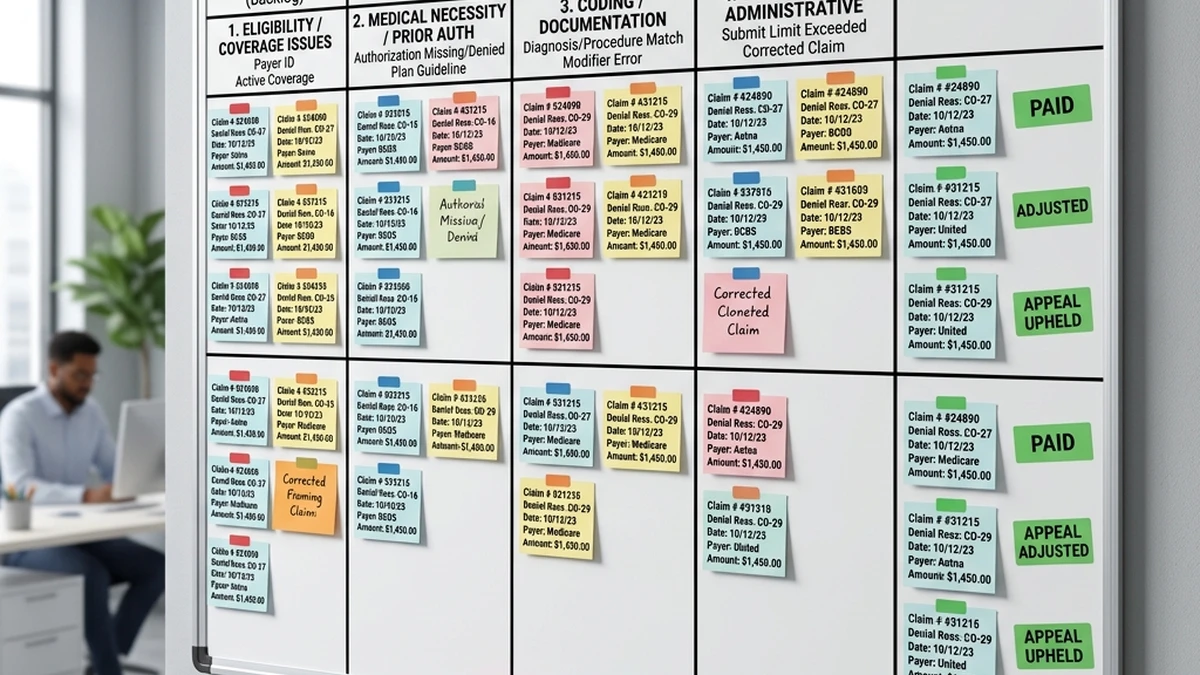
Denial management is the process of identifying, analyzing, and resolving insurance claim denials to recover revenue that would otherwise be lost. Practices that do only reactive denial management are always catching up. Practices that build proactive denial management into their operations see consistent, compounding improvement in their financial performance.
The best practices in this guide address how denials should be categorized, how appeals should be prioritized, and what systemic changes reduce future denial rates. Our denial management services implement all of these practices for Florida healthcare providers.
Categorize Every Denial Before Working It
Before working a denied claim, categorize it by denial reason code, payer, dollar value, and whether it is correctable or non-recoverable. A non-recoverable denial (timely filing missed, service explicitly excluded, patient not eligible with no appeal path) should be written off immediately and the root cause corrected. A correctable denial should be prioritized by dollar value. A disputable denial (medical necessity determination that conflicts with clinical evidence) should go to our insurance denial appeals queue with supporting documentation.
Appeal Prioritization Framework
- Priority 1: High-dollar correctable denials within the appeal window, worked immediately by our denial management team.
- Priority 2: High-dollar medical necessity denials with strong clinical evidence, routed to our insurance appeals specialists.
- Priority 3: Medium-dollar correctable denials that can be resubmitted as clean claims through the clearinghouse.
- Priority 4: Low-dollar denials that are correctable; batch process when possible.
- Do not work: Non-recoverable denials, duplicate denials already resolved, or denials outside the appeal window.
Payer-Specific Denial Strategies
Different payers deny for different reasons at different rates. Medicare denials are often medical necessity or LCD-related. Florida Medicaid denials frequently involve eligibility and authorization issues. Commercial payer denials vary by plan and clinical policy. Building payer-specific denial playbooks is the core of our payer-specific billing services.
Using Denial Data to Drive Upstream Fixes
A denial log that captures reason code, payer, service type, and date of service is the foundation of proactive denial management. Review the log monthly and calculate denial rate by category. Any category that accounts for more than 10 percent of denials warrants a root cause investigation. Root causes almost always trace back to a front-end workflow gap: a missed eligibility check, a PA process that does not catch all required services, or a credentialing gap with a specific payer. Our RCM reporting and analytics platform surfaces these patterns automatically.
Key Takeaways
- Categorize denials as correctable, disputable, or non-recoverable before committing staff time to work them.
- Prioritize appeals by dollar value and likelihood of recovery, not by date of denial.
- Payer-specific denial playbooks reduce time-per-denial and improve consistency.
- A denial log reviewed monthly is the primary tool for identifying upstream process gaps.
- Proactive denial prevention, through eligibility verification and prior authorization management, is more efficient than reactive appeal volume.
Frequently Asked Questions
How long do you have to appeal a denied claim?
Medicare Part B redetermination requests must be filed within 120 days of the initial determination. Commercial payer appeal windows typically range from 60 to 180 days. Missing the appeal deadline forfeits any right to recover the payment. Our denial management team tracks all appeal deadlines across every payer.
What is a peer-to-peer review and when should you request one?
A peer-to-peer review is a direct clinical conversation between the treating provider and the payer medical director, requested after a medical necessity denial. Most payers require the request within 5 to 10 business days of the denial. Our insurance denial appeals team identifies peer-to-peer opportunities and coordinates the scheduling.
What percentage of denied claims should be appealed?
All correctable and disputable denials with sufficient dollar value should be worked. For most practices, about 60 to 70 percent of denied claims are correctable or appealable. Our denial management services pursue every recoverable denial and report the outcomes through monthly RCM analytics.