

Medical Necessity Denial Appeals
Medical necessity denial appeals supported by clinical documentation review. We build payer-specific arguments that demonstrate medical necessity.
How Medical Necessity Denials Are Overturned
Payers deny on medical necessity when the documentation does not establish, in their terms, why the service was required. The appeal has to supply the clinical reasoning against that payer's own coverage policy rather than simply asserting the service was appropriate.
- Payer coverage policy identified before the appeal is written
- Clinical documentation assembled to meet that policy's criteria
- Liability protection reviewed where an ABN applies
- Recurring necessity denials fed back into pre-service screening
Medical Necessity Denial Appeals Explained
Medical necessity denials occur when a payer determines that a service, procedure, or item does not meet their criteria for medical necessity. This is distinct from prior auth denials or eligibility denials because it is a clinical determination: the payer is asserting that the service was not medically required for the patient's condition. These denials require a clinical response built on accurate ICD-10 coding and supporting documentation, not just a technical correction.
Medsure RCS addresses medical necessity denials by building appeals around the payer's specific coverage criteria, the treating physician's clinical documentation, and applicable clinical evidence. Our approach matches the clinical evidence to the payer's exact language, referencing CMS coverage policies and applicable LCDs where relevant, so that every appeal argues the precise point the payer used to support the denial. Medical necessity appeals are a specialized form of insurance denial appeals and require the same medical billing compliance documentation standards.
How It Works: Step by Step
Denial Criteria Review
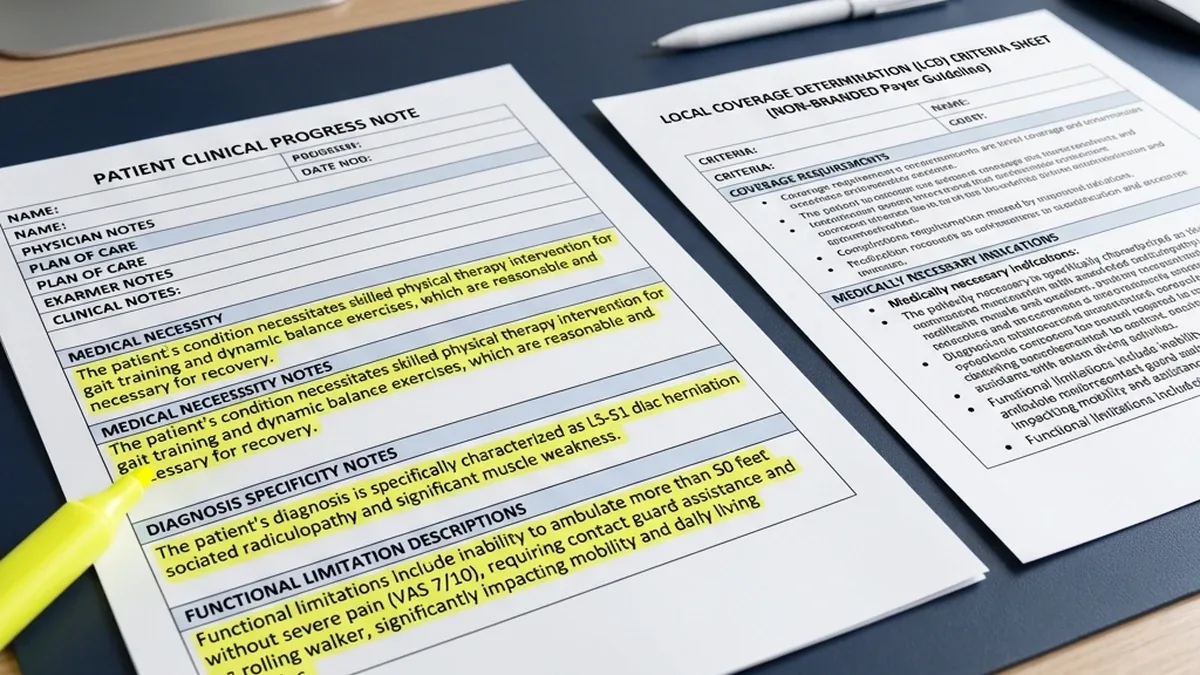
The payer's specific medical necessity criteria (from the applicable LCD, NCD, or commercial policy) are reviewed to understand exactly what the denial is based on.
Clinical Documentation Assessment
The treating physician's notes and records are reviewed to identify documentation that directly addresses the payer's criteria, and to identify any documentation gaps.
Appeal Preparation
The appeal is prepared with a structured argument that maps the clinical documentation to the payer's own necessity criteria and cites applicable clinical guidelines.
Escalation to External Review
When internal appeals are exhausted, medical necessity denials can be escalated to external independent review where a reviewer outside the payer organization makes the determination.
Why This Matters for Your Revenue Cycle
Every appeal addresses the specific payer criteria cited in the denial, not generic medical necessity language.
Medicare medical necessity appeals cite the applicable LCD or NCD criteria directly in the appeal letter.
We pursue external independent review when internal appeal levels are exhausted on appropriate claims.
Clinical records are organized and cited specifically to the payer's review criteria.
Common Mistakes in Medical Necessity Denial Appeals
Submitting a Clinical Narrative Without Addressing Payer Criteria
An appeal that simply reiterates the treating physician's clinical summary without specifically addressing the payer's stated denial criteria will not be successful. The appeal must demonstrate how the specific criteria cited in the denial are met by the clinical documentation.
Not Reviewing the Applicable LCD or NCD Before Appealing
Medicare medical necessity criteria are defined in Local Coverage Determinations (LCDs) and National Coverage Determinations (NCDs). Appeals for Medicare denials must be built around the specific language of the applicable coverage document, not general medical standards.
Stopping After the First Internal Appeal Denial
Medical necessity denials can be escalated through multiple internal appeal levels and then to external independent review. Independent reviewers are outside the payer's organization and are not subject to the payer's internal coverage policies in the same way. External review overturn rates are significant for clinically appropriate services.
Not Identifying Documentation Gaps Before Filing the Appeal
If the treating physician's documentation does not address the payer's specific criteria, the appeal will fail even if the care was appropriate. Documentation gaps must be identified and addressed before the appeal is filed, sometimes through an addendum from the treating provider.
How Medsure RCS Manages Medical Necessity Denial Appeals
LCD and NCD Coverage Analysis
For Medicare medical necessity denials, we review the applicable LCD or NCD to identify the specific coverage criteria and build the appeal argument around the exact language of the coverage policy.
Clinical Documentation Gap Identification
Prior to appeal filing, we identify specific gaps between the treating physician's documentation and the payer's stated criteria, allowing for targeted addenda or supplementary documentation.
Evidence-Based Appeal Preparation
Appeals for complex medical necessity denials are supported with references to applicable clinical guidelines, peer-reviewed literature, or specialty society standards where relevant to the payer's criteria.
External Independent Review Coordination
When internal appeal levels are exhausted, we coordinate external independent review submissions with complete clinical records and appeal history for the reviewer.
Medical Necessity Denial Appeals, Frequently Asked Questions
A prior authorization denial occurs before service when the payer declines to approve the service in advance, or after service when no authorization was obtained. A medical necessity denial occurs after service when the payer reviews the claim and determines that the service did not meet their clinical criteria for coverage, regardless of whether authorization was obtained.
An LCD (Local Coverage Determination) is a Medicare Administrative Contractor's policy defining whether a specific service is covered for Medicare patients in their jurisdiction, and under what clinical conditions. Medicare medical necessity denials are almost always based on the applicable LCD criteria, which must be addressed directly in any appeal.
A treating physician letter strengthens an appeal but is rarely sufficient on its own. The letter must specifically address the payer's denial criteria, reference the applicable clinical documentation, and explain how the patient's condition meets the medical necessity standard. A letter that simply asserts the service was needed without engaging the payer's criteria is unlikely to be successful.
External independent review is a process by which a denied appeal is reviewed by a reviewer outside the insurance company. Under the ACA, most commercial plans must offer external review for medical necessity and experimental/investigational denials. The external reviewer's decision is binding on the insurer. External review success rates are higher than internal appeal rates for many denial types.
Ask About Medical Necessity Denial Appeals
Ready to Improve Your Medical Necessity Denial Appeals?
Talk to a Medsure RCS specialist. No commitment, no pressure, just answers.
Sign up for our newsletter to receive updates, industry news, and articles about medical billing and revenue cycle management.