
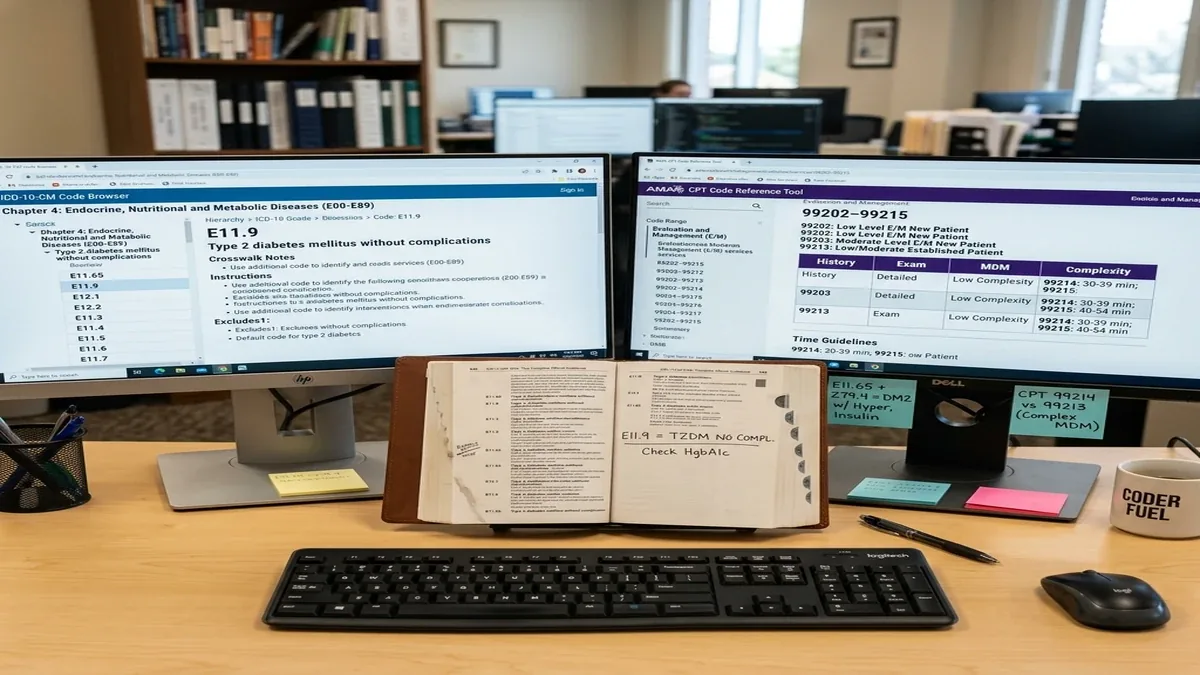
Every medical claim submitted to a payer contains at least two types of codes: a diagnosis code that explains why the service was necessary, and a procedure code that describes what was done. Using the wrong code, an insufficiently specific code, or a code combination that does not pass medical necessity criteria will result in a denial. Understanding what each code set does and how they interact is foundational to billing accuracy.
Three code sets dominate medical billing in the United States: ICD-10-CM for diagnoses, CPT for professional procedures, and HCPCS Level II for supplies, drugs, and non-physician services. Each is updated on a defined schedule, and using outdated codes is one of the most common sources of preventable denials. Our ICD-10 coding and CPT coding services keep code libraries current.
ICD-10-CM: Diagnosis Codes
ICD-10-CM (International Classification of Diseases, 10th Revision, Clinical Modification) is the code set used to document patient diagnoses on every claim. It is maintained by the Centers for Disease Control and Prevention (CDC) and updated annually on October 1 by CMS. Specificity matters: a code for "fracture of the right radius, initial encounter" is not interchangeable with "fracture of the right radius, subsequent encounter." Payers use diagnosis codes to determine whether the service billed meets medical necessity criteria.
CPT: Procedure Codes
Current Procedural Terminology (CPT) codes are maintained by the American Medical Association (AMA) and updated annually on January 1. They describe the services performed by physicians and other qualified healthcare providers. Category I codes describe procedures that are widely performed. Category II codes are optional tracking codes used for quality reporting. Category III codes are temporary codes for emerging technologies.
HCPCS Level II: Supplies, Drugs, and Equipment
HCPCS Level II codes cover services not described by CPT, including durable medical equipment, prosthetics, orthotics, supplies, ambulance services, and many injectable drugs. They are maintained by CMS and updated quarterly. Medicare and Medicaid require HCPCS Level II codes for the services they cover.
How Code Sets Work Together on a Claim
A claim must contain both a diagnosis code (ICD-10-CM) and a procedure code (CPT or HCPCS) for each service line. The diagnosis code must support the medical necessity of the procedure code. Payers use Local Coverage Determinations (LCDs) for Medicare and clinical policy bulletins for commercial payers to define which diagnoses support which procedures. Our medical coding audit reviews code-to-diagnosis linkages across your entire claim history.
Key Takeaways
- ICD-10-CM codes document the diagnosis; CPT and HCPCS Level II codes document the procedure.
- Diagnosis and procedure codes must be linked in a way that supports medical necessity.
- ICD-10-CM updates annually on October 1; CPT updates annually on January 1.
- Specificity in ICD-10-CM coding is required; unspecified codes are frequently rejected by payers.
- Modifiers add information to CPT codes and are required in many billing scenarios.
Frequently Asked Questions
What is a modifier in medical billing?
A modifier is a two-character code appended to a CPT or HCPCS code to communicate additional information about the service, such as which side of the body was treated, or that a service was distinct and independent from another service billed on the same date.
What is the difference between ICD-10-CM and ICD-10-PCS?
ICD-10-CM is used for outpatient and physician billing to document diagnoses. ICD-10-PCS is used exclusively in inpatient hospital settings to code procedures. Physician practices use CPT for procedures, not ICD-10-PCS.
How do local coverage determinations affect billing?
Medicare Local Coverage Determinations (LCDs) define which diagnosis codes support coverage for specific procedures in a given geographic region. If the diagnosis code on the claim is not listed as covered in the applicable LCD, Medicare will deny the claim for lack of medical necessity. Our medical coding services include LCD compliance review for all Medicare claims.