

ED E/M Levels 99281-99285: 2023 Rules and Modifier 25
ED E/M levels 99281-99285 are set by MDM alone since 2023. Critical care 99291, modifier 25, facility levels and denials.
Quick Summary: ED E/M Levels 99281 to 99285
Since January 1, 2023, emergency department E/M levels 99281 to 99285 are selected by medical decision making (MDM) alone, not by time and not by history and exam. Critical care 99291 and 99292 is the time-based exception, and the hospital facility level follows the hospital's own resource guidelines, not the physician's MDM.
- 99282 maps to straightforward MDM, 99283 to low, 99284 to moderate and 99285 to high.
- 99281 no longer needs a physician or other qualified professional and carries no MDM level.
- Critical care starts at 30 minutes (99291) and adds 99292 after 74 minutes under Medicare.
- Procedures in the ED often need modifier 25 on the visit code, and a same-physician repeat repair uses modifier 76.
ED E/M Level Billing Explained
ED E/M levels 99281 to 99285 are chosen by MDM alone. The 2023 CPT changes removed the old three-key-component scoring, so history and exam no longer set the level and time is not used at all for these five codes. CPT still expects a medically appropriate history and exam, but they do not pick the level. The physician and the hospital still reach their levels by different rules, which is where many ED claims go wrong.
Medsure RCS reviews ED charts against the MDM table before claims go out, and this page sits under our emergency medicine billing hub. The wider rules for picking levels are in E/M coding, and the procedure rules are in the modifier 25 and modifier 76 pages. Medicare-specific handling is covered under Medicare billing, and every denied ED claim goes through denial management. Lower-acuity walk-in visits are coded as office visits instead, as shown in the urgent care coding guide.
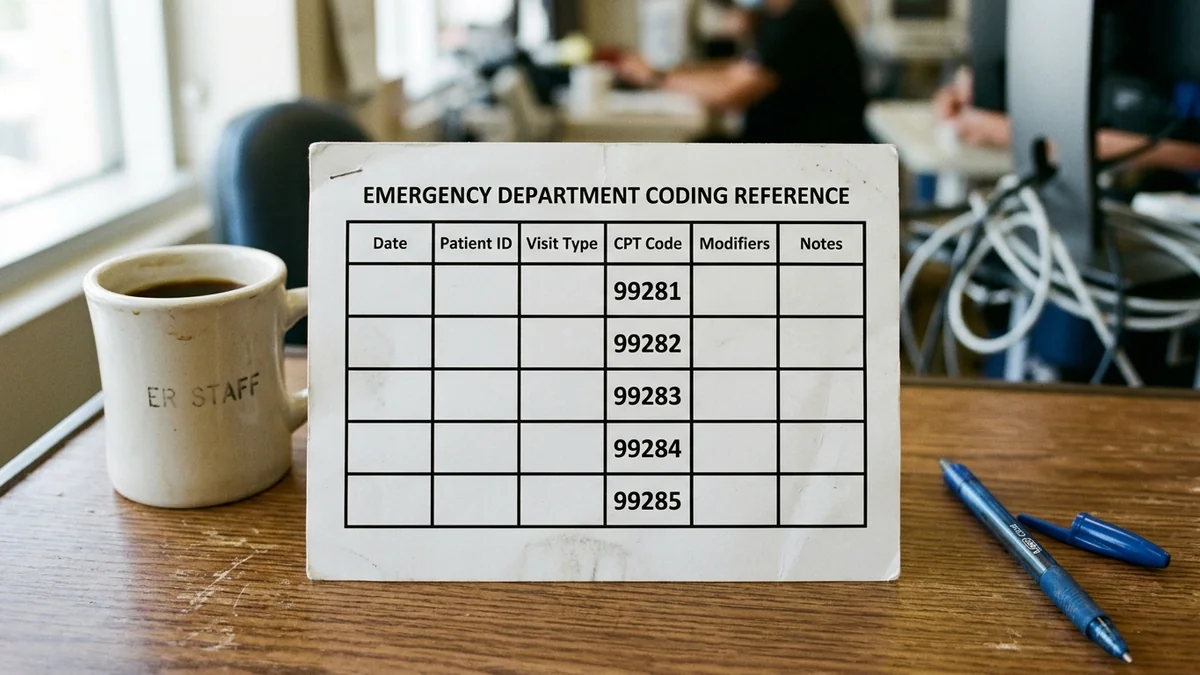
What Changed in ED E/M Coding in 2023
Before 2023, ED codes were scored on history, exam and MDM. CPT deleted those descriptors and rewrote 99281 to 99285 around MDM, so the level now follows the problems addressed, the data reviewed and the risk of management. Two of the three MDM elements must be met. Time is explicitly not a descriptive component of the ED levels, according to the CPT language quoted by the American College of Emergency Physicians (ACEP). History and exam are still expected to be medically appropriate, but they do not select the level. CMS adopted the revised E/M guidelines for all E/M codes on January 1, 2023, so the same MDM-based rule applies to Medicare. Older ED coding habits built on counting history elements or timing the encounter no longer apply to these five codes.
How Does MDM Map to Each ED Level
- 99281: an ED visit for a patient who may not require the presence of a physician or other qualified professional. CPT does not assign it an MDM level. The 2023 descriptor change removed the earlier problem-focused history, exam and straightforward MDM requirement.
- 99282: straightforward problems, minimal data, minimal or no risk. Before 2023 this level was tied to low MDM.
- 99283: low problems, limited data, low risk.
- 99284: moderate problems, moderate data, moderate risk. Two of the three elements at moderate support the level.
- 99285: high problems, extensive data, high risk, such as an acute illness that threatens life or bodily function.
- Searches for a level 3 ED visit with moderate severity usually reflect older descriptor wording. Under the 2023 table, level 3 (99283) matches low MDM, and moderate MDM starts at level 4 (99284).
ED Critical Care Coding
How is ED Critical Care coding done?
Critical care is the direct delivery of care to a patient with acute impairment of one or more vital organ systems and a probability of imminent or life-threatening deterioration. Medicare adopts the CPT definition and rules. Report 99291 for the first 30 to 74 minutes of critical care on a date, once per date, even if the time is not continuous. Report 99292 for each additional 30 minutes after that, which means 104 total minutes for the first unit of 99292. Time spent on separately reportable procedures is not counted toward critical care time. Certain services are bundled into critical care and not billed separately by the practitioner during that time, including chest X-ray interpretation, pulse oximetry, blood gases, interpretation of physiologic data such as ECGs, gastric intubation, ventilator management and vascular access. The note must record total critical care time, not necessarily start and stop times. If an ED visit happened earlier on the same date, before the patient needed critical care, both can be billed when the record shows the earlier visit was medically necessary and separate from the later critical care, and Medicare requires modifier 25 on the claim in that case. When a physician and a nonphysician practitioner in the same group share critical care, the claim carries modifier FS and the practitioner who spent more than half the time bills it.
Using Modifier 25 and Modifier 76 Correctly
How do I use Modifier 25 and Modifier 76 correctly?
Minor procedures, with 0 or 10 day global periods, include the decision to perform them. Under the NCCI policy manual, an E/M on the same day carries modifier 25 only when it is significant, separately identifiable and goes beyond the usual work of the procedure. A CMS hospital billing example shows exactly this pattern: a 99283 line with modifier 25 billed alongside two repair codes under the ER revenue code. Document the evaluation separately from the repair, such as a work-up for the cause of the injury, in the note. A common exam question asks which modifier applies when an intoxicated patient receives stitches, becomes combative and tears them out, and the same physician repairs the wound again. The answer is modifier 76, a repeat procedure by the same physician. Modifier 77 is the matching code for a repeat by a different physician, and modifier 58 describes a planned or related follow-up procedure in the postoperative period, which does not fit an unplanned re-repair. Because the original repair has its own global period, confirm how the payer treats a repeat repair for a new injury. Our modifier 76 page has the full rule, and CPT 99284 with modifier 25 is the pairing most payers review.
Facility vs Professional ED Levels
What is the difference between Facility and Professional ED Levels?
A hospital bills its ED visit on a facility claim, usually under revenue code 0450 for emergency room charges. The Medicare Claims Processing Manual explains that CPT E/M codes were designed for physician work and do not describe well the mix of services a hospital provides, so each hospital applies its own internal guidelines. Those guidelines should relate the intensity of hospital resources to the five levels and show real differences between them. Hospitals bill CPT ED codes for Type A emergency departments, which are open 24 hours a day, 7 days a week and licensed or held out as emergency departments, and use separate G-codes for Type B departments. The result is that the professional level and the facility level for the same visit can differ. The physician level reflects the physician's MDM, and the facility level reflects nursing time, supplies and equipment. CMS also requires hospitals to bill a separate charge for the ER visit and for any surgical procedures done in the ER on the same day.
Observation and Admission Coding
How is Observation and Admission coding done?
Observation care now shares codes with inpatient hospital care. CMS merged hospital inpatient and observation visits into a single code set, and ACEP notes that observation services may be reported by time using 99221 to 99223 and 99231 to 99239. Medicare also covers who bills what when more than one physician is involved. An ED physician who sends a patient home bills the ED level. If the patient's own physician admits the patient, that physician bills initial hospital care and the ED physician still bills the ED visit. If an ED physician asks another physician to evaluate a patient, that physician bills an ED code, unless that physician admits the patient, in which case initial hospital care is billed. If a physician asks a patient to meet them in the ED and the patient is not registered as an ED patient, the correct code is an office or outpatient visit.
How Does the Prudent Layperson Standard Protect ED Claims
Federal rules for health plans define an emergency medical condition by symptoms: acute symptoms, including severe pain, severe enough that a prudent layperson with average health knowledge could expect that delayed care would put health in serious jeopardy. Under 45 CFR 147.138, covered plans must cover emergency services without prior authorization and without regard to whether the provider is in network. Florida adds rules for health maintenance organizations in section 641.513 of the Florida Statutes. An HMO may not require prior authorization for emergency care or deny payment because the hospital did not notify it. It must pay for the screening and evaluation needed to decide whether an emergency medical condition exists, as well as the emergency services themselves. A claim denied as a non-emergency after a minor final diagnosis may be appealed on these grounds. Our Florida Medicaid billing page covers the separate Medicaid rules.
Common ED Level Denials
What are the most common ED Level denials?
- 99285 with no documented high risk: the note lists tests but not the decision about hospitalization, escalation of care or a threat to life or bodily function.
- Data not credited: results reviewed or ordered are not stated, or an independent historian is not recorded.
- Missing modifier 25: the visit is bundled into a laceration repair or other minor procedure and denied.
- Critical care without total time: 99291 is denied or recoded to 99285 because the minutes are not documented.
- Bundled work billed with critical care: ECG interpretation, chest X-ray reading or pulse oximetry charged separately during the critical care period.
- Nonemergency complaint at a high level: CMS says a lower ED level would normally be reported for a nonemergency condition, so payers question level 4 and 5 for minor complaints.
- Wrong site or registration: ED codes billed when the patient was never registered in the ED, which should be an office visit.
- Facility and professional claims that disagree: the facility level is pointed to as proof that the physician level is too high, or the reverse, though they follow different rules.
More Emergency Medicine Billing Services Guides
ED Claim Denials and the Prudent Layperson Standard
Why emergency department claims get denied and how the prudent layperson standard, EMTALA and Florida law protect ED payment. Appeal tips for billers.
Emergency Room Revenue Codes (045X) and ER Facility Billing
Emergency room revenue codes explained: 0450, 0451, 0452, 0456, 0459, Type A vs Type B ED visit codes, and how to bill ER procedures on a facility claim.
Related Services
Emergency Medicine Billing Services
Learn MoreEvaluation and Management (E/M) Coding
Learn MoreModifier 25: Significant Separately Identifiable E/M Service
Learn MoreModifier 76: Repeat Procedure by Same Physician
Learn MoreMedicare Billing Services
Learn MoreDenial Management Services in Florida
Learn MoreED E/M Level Billing, Frequently Asked Questions
By medical decision making alone since January 1, 2023. 99282 matches straightforward MDM, 99283 low, 99284 moderate and 99285 high. History and exam are expected to be medically appropriate but do not set the level, and time is not used.
The descriptor now describes an ED visit for a patient who may not require the presence of a physician or other qualified health care professional. It no longer lists a problem-focused history, exam and straightforward MDM.
Report 99291 for the first 30 to 74 minutes of critical care on a date, once per date. Add 99292 for each additional 30 minutes after 74 minutes. Document the total critical care time, and leave out time spent on separately reportable procedures.
When a procedure with a 0 or 10 day global period is done the same day and the ED visit was significant and separately identifiable from the usual pre-procedure work, add modifier 25 to the visit code. The note should show the separate evaluation.
Modifier 76, repeat procedure by the same physician. Modifier 77 is for a repeat by a different physician. Modifier 58 describes a planned or related follow-up procedure in the postoperative period.
Not necessarily. The physician level follows MDM, while the hospital facility level follows the hospital's own guidelines tied to the resources used. Hospitals bill ER charges under revenue code 0450.
It is a test based on symptoms. If acute symptoms, including severe pain, were severe enough that a prudent layperson with average health knowledge would expect serious harm from delay, the condition is treated as an emergency regardless of the final diagnosis. Federal rules require covered plans to pay emergency services without prior authorization.
Ask About ED E/M Level Billing
Ready to Improve Your ED E/M Level Billing?
Talk to a Medsure RCS specialist. No commitment, no pressure, just answers.
Sign up for our newsletter to receive updates, industry news, and articles about medical billing and revenue cycle management.